

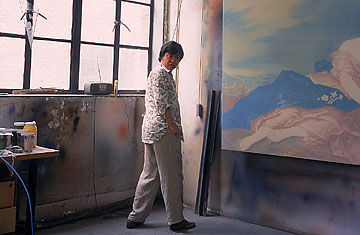
Shanghai artist Zhou Tiehai
(2 of 3)
Despite the tradition-steeped training, it was impossible for many of Asia's artists to ignore the tremendous social changes taking place outside their classrooms. Indian painter Maqbool Fida Husain, for example, marries myths with modernism in his oil canvases, one of which sold for $2 million in 2005. Fame, however, hasn't insulated the now 92-year-old from controversy. Right-wing Hindu political parties were incensed when Husain painted a series depicting Indian deities in the nude. Although criminal complaints against him were dropped in 2004 by the New Delhi High Court, attacks against the painter were rekindled last year when an Indian newsweekly published an advertisement featuring a Husain painting in which a naked representation of mother India draped herself across a map of the country. Husain was promptly charged with "hurting the sentiments of Hindus." In response, he withdrew the painting from auction and now lives in self-imposed exile in Dubai and London.
Husain's experience hasn't prevented younger Indian artists from venturing into similarly treacherous political terrain. In May, a visual-arts student at Maharaja Sayajirao University of Baroda — regarded as one of India's top schools for art — was imprisoned for five days after his paintings of religious imagery were deemed hurtful to both Hindus and Christians. If convicted of "promoting enmity between different groups on grounds of religion," the student could face several years in jail.
By contrast, in Vietnam political expression is so perilous that self-censorship has become an art form among even the most daring painters. Those who do try to cross the line face swift punishment. Tran Luong is one of the country's so-called Gang of Five contemporary artists who first gained international notice in the 1990s for his underwater abstracts. Lately, he has concentrated on performance and video art, documenting the lives of coal miners and street children left out of Vietnam's experiments with the free market. For the past few years, Luong has also encouraged young artists to explore challenging social themes instead of pumping out bland but commercially successful landscapes. Two years ago, he tried to take a group of students to a contemporary-art festival in southern China. Vietnamese authorities stopped them at the border. "The immigration police told me I was not a real artist, so there was no way I could be allowed to go abroad for artistic purposes," recalls Luong, who continues to be hassled by the authorities. Another artist who battles the censors is Truong Tan, who often explores homosexual themes in his Matisse-influenced paintings. Earlier this year, an installation in which Tan constructed a 2-m-high diaper out of police uniforms was promptly shut down. The threat of official interference means that many Hanoi galleries — there are dozens in the art-mad town — prefer to trade in naive village scenes that feel almost deliberately apolitical.
Still, some Vietnamese artists manage to exhibit thought-provoking works. Born in remote mountains that are home to disenfranchised ethnic minorities, Dinh Thi Tham Poong tweaks traditional folk art with contemporary touches. Her canvases capture the tensions between the natural world and the onslaught of Vietnam's economic reforms — all without appearing overtly political. The country's censors likely have a hard time understanding that Poong's whimsical figures scattered across traditional handmade paper could possibly be making a social statement. But it is only in such narrow margins that Vietnam's artists can safely operate.
Ironically, it is China, with its authoritarian government and notorious cultural police, that allows its artists the most room for self-expression. Yes, direct criticisms of the Communist Party are taboo, and the culture cops occasionally shutter avant-garde exhibitions. Nevertheless, ironic depictions of Chairman Mao and not-so-subtle critiques of official corruption or urban alienation fill Beijing and Shanghai galleries. Some artists, particularly those who grew up during the Cultural Revolution, playfully twist that era's socialist-realist propaganda art — think heroic laborers, red-cheeked peasants and stalwart soldiers lifting banners with brand names or consumerist messages. Best known among these political popsters is Wang Guangyi, whose painting of Mao behind bars sold for $4 million last month.
Another band of Chinese artists has pushed boundaries by depicting the lost souls trying to find their place in a rapidly developing society. Surrounded by the capitalist trappings that China's leaders hope will sate a politically repressed populace — chic clothes, cell phones, fast-food wrappers — these lonely figures wear blank or artificially cheery expressions. "As a child, my classmates and I sang revolutionary songs, and we had to write Mao's expressions over and over," says 43-year-old Zeng Fanzhi, whose portrait of a masked man with a cauterized visage sold for $1.63 million in London last month. "Then, suddenly we were told, 'That's finished, you will love money now.'" Puffing on a Cuban cigar at a five-star hotel's café in Shanghai, Zeng gazes at the other patrons. Next to him, a man in red silk pajamas leans over to slurp coffee from a dainty cup resting on the table. Nearby, a prostitute in a leopard-print minidress has arranged herself in an armchair, presumably waiting for a customer. "People are so confused and crazy now," Zeng says. "It's impossible for my art not to reflect that."