

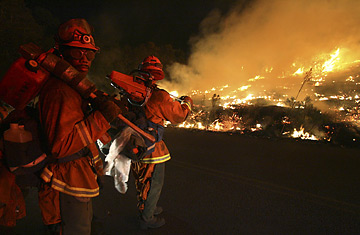
Firefighters watch a backfire on a hillside in Jamul, Calif., Tuesday, October 23, 2007.
The Santa Ana winds begin cold, gathering power and mass in the high desert between Las Vegas and Los Angeles. Air pressure pushes the winds up and over the San Gabriel Mountains, westward toward the Pacific Ocean, until gravity takes hold. The air becomes compressed as it drops, growing hotter and dryer, stripping moisture from the ground, accelerating--sometimes past 100 m.p.h. (160 km/h)--as it squeezes through Southern California's many canyons.
The punishing gusts of the Santa Anas herald cursed weather, days and nights of devilish heat. Should a fire spark in the dry woodlands surrounding the region's cities and suburbs, the winds become a flamethrower, spreading glowing embers half a mile (800 m) or more. The Santa Anas have been midwife to the most destructive wildfires in California's history, from the Great Fire of 1889 to the 2003 disaster that blackened nearly 700,000 acres (280,000 hectares) of forest. Lifelong residents of the state know the Santa Anas and dread them. As Joan Didion has written, "The wind shows us how close to the edge we are."
This week the people of Southern California may have reached that edge. "We're in a state of shock right now," says Dr. Zab Mosenifar, director of the Cedars-Sinai Women's Guild Pulmonary Disease Institute in Los Angeles, who was preparing for an influx of smoke-inhalation victims at his hospital. "This is beyond thinking." Beginning overnight on Oct. 20, unusually fierce Santa Ana winds stoked fires that quickly burst into life throughout a dry, hot landscape. By midweek, more than 20 separate blazes formed pockets of fire running from the Mexican border north to Simi Valley outside Los Angeles. In many places, the heat and smoke were so intense that the 7,000 firefighters recruited from around the country could do little but watch. The flames consumed more than 400,000 acres (162,000 hectares), destroyed more than 2,000 houses and forced the temporary evacuation of nearly 1 million people--the biggest mass migration in the U.S. since Hurricane Katrina, and far more than were evacuated during the 2003 San Diego wildfires, previously considered California's worst.
In San Diego County, site of the worst fires, people spent a few minutes gathering some mementos before abandoning their houses ahead of the flames, seeking refuge with relatives or friends or even in Qualcomm Stadium, which went from being the home of the San Diego Chargers to a temporary shelter for more than 20,000 refugees--stirring worrisome memories of the tens of thousands who swarmed to the Superdome in New Orleans two years ago. Hotels filled quickly, highways jammed and grocery-store shelves ran bare. Some residents learned of the danger through television coverage of the fire. The images of the flames they couldn't yet see out their windows but knew were on the march only added to an atmosphere of terror. "Everyone is running around scared," said Dr. Sanjana Chaturvedi, a San Diego resident who fled her home with her husband and two children. "No one knows what to do. There is no place to go. I have no place to go."
Often the flames moved faster than the residents. When Jay Blankenbeckler went to bed the night of Oct. 21 at his home in Rancho Bernardo, he could see smoke, but the fire still seemed far away. Upon awakening early the next morning and turning on the TV, he saw a newscaster reporting in front of a blaze--one that was less than half a mile from Blankenbeckler's house. "It had already burned through an entire neighborhood," he says. "That's when I thought, 'This is real.'"
The Government Steps In
State and federal officials did their best to quell the anxiety of refugees and of people who, at least for the time being, were still in their homes. California Governor Arnold Schwarzenegger was in full action-hero mode, traveling to the firefighters' front lines, while President George W. Bush--chastened by Washington's dilatory response to Katrina--declared the region a "major disaster" and promptly dispatched Homeland Security Secretary Michael Chertoff, along with Army helicopters, troops and millions of dollars in federal aid. San Diego city officials even implemented a reverse 911 system with automated warning calls going to residents, urging them to evacuate. This early and aggressive emptying of the region--a hard-earned lesson of the 2003 fires, which left 20 people dead--likely saved Californians' lives, if not their property. "The issue this time is not preparedness," said San Diego City Council president Scott Peters. "It's that the event is so overwhelming."
The question is, Why? Fires have always been with us and are one way nature cleans house, burning off dry vegetation and opening up old ground for new growth. So why have these natural events become natural disasters? Why do there seem to be more of them, and when they do strike, why are they ever more catastrophic?
The Development Scourge
Part of the reason Southern California has become such a dangerous place to live is that it's such an attractive place to live. The migration of people drawn to the West by the region's mountains, forests and proximity to the ocean has led to more and more new residents building houses on the shrinking borderlands between edge suburbs and untouched wilderness. More than 8.6 million Western homes have been built within 30 miles (50 km) of national forest since 1982; in California, where the population has more than tripled since 1950, in excess of 50% of new housing has been built in a severe-fire zone. That's risky for obvious reasons: if more people choose to live in areas threatened by fire, more people will be in harm's way when disaster finally strikes. But those houses, especially if owners fail to prioritize fire safety, are often more sensitive to fire than are untouched forests, and just a few scattered houses in the woods can amplify a wildfire. "Isolated homes surrounded by natural vegetation are probably the most dangerous combination for fires," says Jon Keeley, a research ecologist with the U.S. Geographical Survey (USGS). Beyond providing fuel for the flames, new dwellings also concentrate the single biggest cause of wildfires: us. The downed power lines, careless barbecues and abandoned campfires that frequently spark fires don't happen in the absence of people. And then there is the wicked wild card of arson. Perhaps only one person in a community of thousands has a hand in triggering a blaze, but the very presence of those thousands is what turns an otherwise messy event deadly. "The same fires happening wouldn't be anywhere near as serious without this development pattern," says Volker Radeloff, a forest ecologist at the University of Wisconsin.