

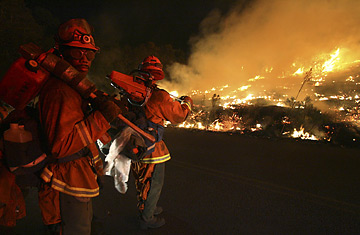
Firefighters watch a backfire on a hillside in Jamul, Calif., Tuesday, October 23, 2007.
(2 of 3)
Then, too, there's climate change. As occurred after Hurricane Katrina, the question of what role global warming might have played in the disaster arose before the fires had even begun to die down. While environmental scientists are careful not to blame the droughts or heat waves of any one season on climate change, the overwhelming majority of climate models point to more of these extreme conditions in the already dry Southwest as the planet warms. A study led by researchers at the Scripps Institution of Oceanography in La Jolla, Calif., and published in Science last year found that as temperatures increased in the West, which is now 1.5° (almost 1°C) warmer than it was in 1987, so did the length of the wildfire season and the size and duration of the average fire.
Fighting and Feeding The Flames
Even when we try to be smart about fires, we often just make things worse. For more than a century, the U.S. Forest Service--the federal agency responsible for combatting wildfires--has pursued a policy of stamping out blazes wherever they occur and doing so all the more aggressively as population grows in the endangered regions. For those accustomed to living in urban areas, that makes sense--the job of a city fire department is to stop blazes before they damage property. But that's not how things work in the great Western forests. Paradoxically, trying to put out every minor blaze may raise the risk for the occasional megafire since the forests are not permitted to do their important work of occasionally clearing out accumulated vegetation. This is a little like letting newspapers pile up in your kitchen: if a fire occurs, the place is primed to blow. "These larger and more severe wildfires are an unintended consequence of a suppression policy that doesn't work," says Richard Minnich, a wildfire ecologist at the University of California at Riverside. "If anything, suppression actually endangers society."
The situation was worsened by a relatively wet winter in 2004-05, which let trees and scrub grow densely, followed by extremely dry weather since, which turned the vegetation to still more fuel. In fact, this past year has seen the worst drought in Los Angeles' recorded history. Adding to the tinder were those Santa Ana winds, which strike regularly in the autumn but rarely with the power of the past week. "They usually come in small, medium and large," says Bill Patzert, a climatologist with NASA's Jet Propulsion Laboratory in Pasadena, Calif. "These were Godzilla winds."
A Losing Battle
As more houses are dispersed through the fire zone--whether summer cabins or new McMansions--both firefighters and budgets are stretched ever more thinly. Last year the Forest Service spent a record $2.5 billion fighting wildfires that burned 9.9 million acres (4 million hectares), another record. Even though California has boosted spending on firefighting since the catastrophic blazes of 2003--the state set aside $850 million for this year--when a megafire like this one strikes, officers on the ground quickly hit the limits of what they can do. "You're putting people between the unstoppable force of a wildfire and the immovable object of a home," says Timothy Ingalsbee, executive director of Firefighters United for Safety, Ethics and Ecology. "That's as unsafe a position as you can be in as a firefighter."
A frightening possibility is that the October wildfires may be only the start--not just of future fires in future seasons but of more to come this year. The Santa Ana winds have just begun and typically peak in the winter. What's more, there is not likely to be much relief from drought conditions. The National Weather Service predicts a La Niña pattern this winter, which occurs when sea-surface temperatures in the equatorial Pacific Ocean are cooler than usual. La Niña usually translates to dryer and hotter weather in the American South.
The long-term forecast isn't any better. Few scientists expect dry areas like the Southwest to do anything but grow dryer still. The past several years have been among the dryest on record in the West, leaving the Colorado River--which supplies water to 30 million people--at its lowest level in 85 years of measurements. If the mountain snowpack that stores much of the water used by the West were to melt because of higher temperatures, all the reservoirs in the world might not be enough to keep the region wet. Even if the effects of climate change turn out to be milder than feared, the same population growth that puts people in the way of fires also strains the scarce water supplies needed to fight them. In San Diego County, home to one of the fastest-growing metro areas in the U.S., water use has risen by about 34% since 1995. "We've set ourselves up for this," says JPL's Patzert. "We've been handing out building permits without considering the requirements for water."
The Outlook
Does all this mean that the only way to stop the cycle of catastrophic forest fires is to change the way Americans live in the West? Probably--but the transition will be painful. Population growth in the affected areas has implicitly been supported by federal policies that protect private homes even if they're built in risky areas. This, in turn, has caused the Forest Service--which is supposed to perform a range of wilderness functions--to become largely a firefighting agency, devoting nearly half its budget to that one job. That has caught the eye of Congress, which wants spending to be brought under control. The loss in recent years of several firefighters who died protecting homes has further caused Washington to rethink its policies. "So much development in California has followed the pioneering spirit," says Keeley of the USGS. "But we're reaching critical limits in growth, and people have to realize that they will lose certain freedoms if they want to be safe."