

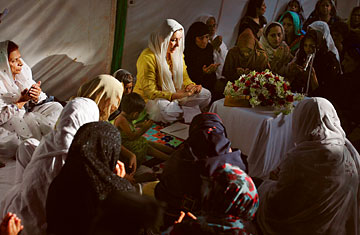
Bhutto prays with women who lost their husbands in the Oct. 18 suicide-bomb attacks, which turned her triumphant return into a tragedy
(2 of 2)
A Duet with a Dictator
The broad terms of the alliance between Bhutto and Musharraf may see her become Prime Minister for the third time if the PPP wins a parliamentary majority in January. The general would retain the powerful post of President even as he steps down as army chief. But PPP stalwarts fear such a scheme will alienate many Pakistanis. "Party members are saying that their constituencies are telling them not to ask for votes because the educated voter sees the deal as absolving [accused] politicians," says Ayesha Tammy Haq, a talk-show host.
Even if her party sweeps the elections, Bhutto faces an awkward power-sharing arrangement with a longtime political foe. Musharraf, as President, has the ability to dissolve Parliament. Removing that constitutional amendment, which Musharraf has already used once to oust Bhutto, will require a two-thirds majority in Parliament, a majority that many PPP members think is beyond them. Bhutto says Musharraf was not involved in last week's attack, but she suspects fundamentalist Islamic groups historically affiliated with his military regime. "I am not blaming the government," she says. "But I am saying there are elements within the administration and the security apparatus that sympathize with those groups."
Bhutto has defended her negotiations with Musharraf, saying that the current situation calls for extreme measures. "This is a battle for democracy, and we wish it to be peaceful," she says. "He's been the victim of assassination attacks and [now] so have we. I think certainly it will unite all those who are against extremism."
A Freer Press
One of the positive — and popular — changes under Musharraf is the rise of independent media. Scores of privately owned television and radio stations have helped create a media landscape new to Bhutto. "The media have become quite feisty," says Haq. "Bhutto is going to have to learn how to deal with them. They will be gentle at first, but that won't last long. She will have to learn how to answer difficult questions. Reciting rhetoric and party lines won't be enough."
January's will be the first parliamentary election that will be televised; that disadvantages Bhutto, who is at her best when she is out in the streets pressing the flesh. Many party supporters, such as Amida Manzoor from Lyari, stayed home to watch the events unfold on TV instead. Manzoor stayed up all night watching the footage of Bhutto's rescue from the terrorist attack, and says because of that, she no longer believes the party line about caring for the people. "The leaders all fled in their special cars after the bombs. They did not care about the workers who came to support her. They should have rushed them to the hospital in their nice cars; instead, everyone had to wait for ambulances and volunteers to be rescued."
Great Expectations
On at least one local front, Bhutto has had a hard act to follow. Musharraf's tenure has seen the economy grow by an average 7% a year. While some of that growth stems from the lifting in 2001 of U.S. sanctions put in place when Pakistan tested its first nuclear weapon nine years ago, Pakistan's business classes will expect Bhutto to maintain the momentum. At the same time, the urban and rural poor that make up her base want work. "Bhutto has promised us jobs," says Asif Ali, an unemployed Lyari resident. "She has said that she will give us clean drinking water. If she does not do this, she will see how the residents of Lyari can resist against her."
The War on Terror
Even more difficult to manage will be Washington's expectations that Bhutto take strong action against militants. Bhutto has suggested that Musharraf has not done enough to tackle extremism, but she has offered no concrete solutions of her own, other than promoting democracy as the panacea for Pakistan's ills. "It has become clear that dictatorship doesn't work, that it is actually making the situation more chaotic and anarchic," she says. "And it is chaos and anarchy that actually suits the militants."
More than two dozen militant attacks have taken place in the past two months alone, and every major international terror plot since the toppling of the twin World Trade Center towers on Sept. 11, 2001, has been traced, in some way, back to Pakistan. In July a U.S. National Intelligence Estimate report said that the tribal districts of North and South Waziristan, on the lawless border with Afghanistan, are a "safe haven" for al-Qaeda.
It's the hope of the Bush Administration that a power-sharing agreement between Bhutto and Musharraf would lend the military leader the democratic credentials necessary to pursue his war on terror, but many analysts say it is already too late. "The situation in Waziristan is deteriorating rapidly," says Zafar Iqbal Cheema, chair of the Defense and Strategic Studies Department at Islamabad's Quaid-i-Azam University. "The military has become so demoralized that forces are surrendering. It's a very grim situation."
What started as the U.S.'s war on terror has become Pakistan's own war, but it still carries an American connotation that sits uneasily on the Pakistani consciousness. Bhutto, as leader of the country, could do little to inspire an unpopular war against fellow Muslims that is largely seen to be at Washington's behest. "Benazir's problem is that she is talking against the wind," says Moonis Ahmar, chair of the International Relations Department at Karachi University. "The wind here, right or wrong, is anti-West. Whatever the reasons — Afghanistan, Iraq, Palestine or the war on terror, which is seen as war on Islam — the mood is anti-American. And in that environment, to go in and say, 'I will take strong action against the people in the tribal areas' will backfire. Even Musharraf, with his military, has not been able to do this. As long as she has this pro-American posture she will continue to be targeted."
For Bhutto, balancing the demands of her country with those of other nations depending on her to solve the scourge of radicalism will be her greatest challenge yet. "We are prepared to risk our lives and we are prepared to risk our liberty, but we are not prepared to surrender our great nation to the militants," says Bhutto. Extremists have already put her to the test once. No doubt they will do so again.