

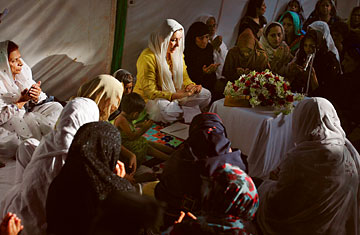
Bhutto prays with women who lost their husbands in the Oct. 18 suicide-bomb attacks, which turned her triumphant return into a tragedy
The day Benazir Bhutto returned to Karachi after exile in 1986, Nazir Ahmad Baloch woke up early, pinned a button of Bhutto's Pakistan People's Party (PPP) to his shirt and danced out the door chanting "Long Live Bhutto." "He was crazy," says his aunt, Anipa Banno. "The party never did anything for him, but he believed in their slogan, 'Bread, Shelter and Clothes.' He was a party diehard." Bhutto had fled Pakistan when her father, former President and Prime Minister Zulfikar Ali Bhutto, was toppled in a military coup and later executed. But she went back to pick up her father's mantle as head of the PPP, and eventually led the party to election victory, becoming the world's first woman to head a modern Muslim nation. Like many in the sprawling slum city of Lyari, Baloch, though only a child, fell in love with the PPP when the elder Bhutto made it the centerpiece of his campaign to empower Pakistan's poor. "Bhutto came to my house and asked about my problems," says Banno. "Nazir was there with me, waving his little flag." Lyari has been a PPP stronghold ever since.
Last week, Baloch showed he was still devoted to the Bhuttos — even though Benazir had again fled Pakistan in 1999, to escape corruption charges (which she denies) and yet another military coup. Baloch danced out the door once more, leaving his pregnant wife at home, and chanting the same slogans. But this time Baloch did not come home. His nephew found his body in a Karachi morgue, victim of a devastating suicide attack on Bhutto's homecoming procession that saw 141 dead and hundreds critically injured. More than a third of the dead and injured hailed from Lyari. The following day, Bhutto praised those in the PPP who had lost their lives, saying that their sacrifice proved that the people of Pakistan were behind her. But Banno, a veteran party member, felt differently: "The leaders are burnishing their politics over the bodies of these dead workers, but we have nothing but a fatherless child. Let's see if Benazir Bhutto can make it worthwhile."
Benazir Bhutto, twice Prime Minister, says she is Pakistan's best hope. The country she has returned to, however, is not the one she once ruled. Pakistan is altogether more violent than ever. (Both al-Qaeda and local militants are suspected of being behind the attack on Bhutto, but she has accused rogue government and security officials of involvement.) Moreover, Bhutto can no longer count on unqualified support of party followers who first vaulted her to power in 1988, and again in 1993. And after eight years under President Pervez Musharraf, the general who seized power in that 1999 coup, Pakistan has become increasingly polarized: the civilian population wants democracy back, a fundamentalist religious fringe seeks the establishment of an Islamic state and the military is bent on holding on to power. How Bhutto, 54, negotiates this minefield will largely determine the fate of this nuclear-armed nation of 165 million.
She is off to a mixed start. Musharraf has allowed her to return to Pakistan without fear of prosecution for the corruption charges relating to her two terms in office. A deal, still being negotiated, may also include the lifting of a constitutional amendment limiting Prime Ministers to two terms. This would allow Bhutto to contest planned general elections in January. But Bhutto's talks with Musharraf have divided the PPP — some members see it as a betrayal of their cause to end military rule. An increasingly independent Supreme Court will decide in coming days if Musharraf's amnesty for Bhutto is constitutional. At the same time, the court is weighing the legitimacy of Musharraf's own landslide victory in the presidential election in early October. The upshot is that Pakistan's homecoming queen faces a host of challenges in coming months that will be difficult, perhaps impossible, to surmount.
Campaigning amid Violence
On Sunday Oct. 20, Bhutto, flanked by a small army of armed security guards, made an unannounced stop in Lyari to offer condolences to the families of the deceased. A crowd gathered to hear her speak from the running board of her idling SUV. "I am your sister and the people of Lyari are my own," she told the crowd. "The way you stood behind me, I would stand beside you forever." The crowd erupted in cheers, and an overenthusiastic supporter fired a traditional shot in the air to celebrate. Immediately the object of the crowd's adoration was bundled back into the car, and the motorcade zoomed away.
Bhutto's hit-and-run visit was a radical departure from the PPP's traditional style of massive campaign rallies that are equal parts entertainment and politics. In Pakistan, political strength is often measured by crowd counts, and no other party has been able to match the PPP's draw. "In our part of the world, politicians have to take their campaigns to the street," says political analyst Nusrat Javed. "Bhutto's base doesn't watch TV. They need rallies, cavalcades. Unless you do it this way, you cannot survive as a populist party. Unfortunately, that is no longer possible." Bhutto had planned to launch her election campaign with a procession to her hometown of Larkana, the source of her most fervent support. Now she has been forced to rethink her strategy. "We have to modify our campaign to some extent because of the suicide bombings," Bhutto told reporters at her Karachi residence shortly after visiting Lyari. "But we are not going to stop our campaign to reach the public. We will not be deterred." Some PPP workers are not as enthusiastic. "I won't go to rallies anymore," says Banno. "Anything can happen."