

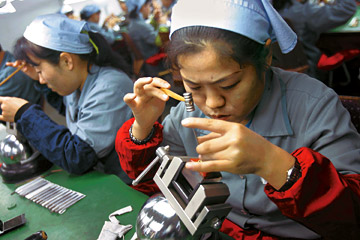
Worker's paradise? A South Korean-funded watch factory in Kaesong is one of North Korea's few functioning businesses
(2 of 2)
To be sure, there's considerable political risk in partnering with a charter member of the "axis of evil." Consider the case of British American Tobacco. In 2001, the cigarette giant entered into a joint venture with a state-owned North Korean conglomerate to operate a factory in the North. But BAT pulled out of the arrangement after a British newspaper revealed details of the deal. Other companies have been scared off by the U.S. trade embargo. "There's already a reasonable amount of investment," says Devonshire-Ellis, who helped the North Korean government rewrite its foreign-investment regulations. "But companies try to keep it very, very quiet. I know one high-end Japanese brand is having clothing finished in North Korea. Another European men's fashion house is getting shirts finished there. The truth is, business executives in New York and Washington are walking around wearing expensive shirts made in North Korea."
Pyongyang has flirted with economic reform before, liberalizing prices and even encouraging some small measure of private enterprise by allowing farmer's markets. But the North's development schemes have often come to naught. Casting about for new investors after the collapse of the Soviet Union, the D.P.R.K. in the 1990s started a free-trade zone in Rajin-Sonbong, a remote area near the country's northeastern frontier. The experiment failed: the zone didn't attract much beyond a few hotels and a casino catering to Chinese tourists. Another special economic zone in Sinuiju, across the Yalu River from the Chinese city of Dandong, faltered in 2002 after the Chinese-Dutch orchid entrepreneur handpicked by Kim Jong Il to run the place was arrested by China for fraud.
The North was emulating an obvious precedent: Shenzhen, the special economic zone where China first experimented with capitalism. In January 2006, Kim Jong Il made a rare foreign visit, traveling by train — he reportedly abhors flying — to the booming south China city. Kim may see China as more than a path to prosperity. "To him it's an assuring message," says Mansourov. "Even if you open up economically, you can still maintain political control for his regime and his family."
Yet just as often as North Korea has opened a crack, it has slammed the door shut. In 2005, for instance, the government suddenly reversed its decision to allow private markets, forcing many North Koreans back into its food-rationing system. And at April's meeting of the Supreme People's Assembly, Kim's government sacked Prime Minister Pak Pong Ju, who had previously led a Cabinet-level economic think tank, and who was seen by some as friendly to reformers. (Pak and his deputies were reportedly trundled off for re-education.) "All of a sudden the wind seems to have gone out of the sail," says Brad Babson, a former North Korea specialist at the World Bank. "The economic reformers were back-benched, and something shifted internally so they got back into this military adventurousness."
Real reform, Babson says, would require North Korea to abandon its pipe dream of agricultural self-sufficiency — with a dearth of arable land, the country is literally dirt poor — and invest in labor-intensive manufacturing. But rebuilding the country's roads and ports and installing a reliable electrical grid would take billions of dollars in international loans — hardly a bright prospect given the country's history of defaulting on its obligations. Even then, by some estimates it will take a decade of investment to bring North Korean incomes up to a mere 55% of South Korea's.
Skeptics, meanwhile, see North Korea's current eagerness for investment as another in Kim's endless series of feints designed to keep his opponents off balance — and the aid handouts flowing. The country relies on foreign aid to feed as much as a third of its population. "The North Korean economic approach has always been to extract resources from outsiders," says Nicholas Eberstadt, a political economist at the American Enterprise Institute and the author of The North Korean Economy. "It's like what they say about champagne: in success, you feel like you deserve it; in failure, you need it."
And the possibility of failure is omnipresent. According to South Korea's central Bank of Korea, the D.P.R.K.'s economy shrank by 1.1% in 2006 after eight years of moderate growth. Under pressure from international sanctions, nearly every sector of the North's Lilliputian economy contracted, with new construction plummeting 11.5%. Torrential rains in August, meanwhile, destroyed an estimated 11% of the country's rice and corn crops, again raising the specter of mass famine like the one that killed up to a million people in the mid-1990s.
Small surprise, then, that Kim seems suddenly amenable to dealing with his erstwhile enemies in Washington and Seoul. Last week, the D.P.R.K. allowed an international team of inspectors to visit its Yongbyon nuclear facility. After the regime promised to shutter its nuclear program, China donated 50,000 tons of heavy fuel oil. The U.S. could follow suit with a similarly sized shipment. And at next month's summit between Kim and South Korean President Roh Moo Hyun, the South could offer North Korea a development-aid package that some experts speculate could be worth $20 billion — no small potatoes to a country in which one of the leading industries is, in fact, potatoes.
But a business opportunity in the North is still far from assured. Should Pyongyang renege on its program to dismantle its nuclear program, crippling U.S. sanctions will almost certainly continue. And South Korean presidential elections in December could usher in a new government with a less conciliatory stance toward its deadbeat neighbor. To see just how far North Korea still has to go, you need only visit the Sino-Korean Friendship Bridge linking the booming Chinese metropolis of Dandong with the sooty failed economic zone of Sinuiju. Commerce between the two nations is limited to a trickle of trucks on the bridge's single lane. At night, the contrast is vividly instructive: Dandong's bustling waterfront turns into a riot of neon, while Sinuiju is pitched into near-total blackness. How will North Korea ever pull itself out of the dark ages if it can't even keep the lights on?