

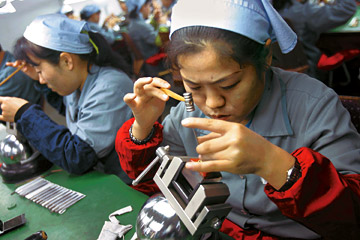
Worker's paradise? A South Korean-funded watch factory in Kaesong is one of North Korea's few functioning businesses
A few years ago, Chris Devonshire-Ellis, a Beijing-based business and tax consultant, was in the bar at Pyongyang's Koryo Hotel when he ran into another foreigner. "The guy's name was Vlad," Devonshire-Ellis says. "He'd come from Moscow on a train to sell tractors to the North Koreans. He had all these guys around him. Turns out, they were his team of bodyguards. The North Koreans paid him in cash — 1 million in U.S. dollars — and that's why he needed the bodyguards. He was comfortable doing business with the North Koreans. He said they always paid. But I must say, the guards with machine guns may be a bit much for the average Western businessman."
Such is the parlous state of commerce in the world's last Stalinist holdout. In recent months, North Korea's dictator, Kim Jong Il, has agreed to a rare meeting with South Korea's President and allowed international inspectors to examine the country's nuclear facilities, raising faint hopes that diplomatic progress in the effort to get Kim to abandon nuclear weapons, along with an easing of the country's self-imposed isolation, might ultimately lead to economic reforms. And for foreign investors lured by what Devonshire-Ellis calls the "barren romance" of the place, North Korea holds obvious, if modest, attractions: a highly literate workforce with average daily wages that are about half what Chinese earn; abundant mineral resources, including coal, iron ore and gold; a cash-on-the-barrel economy; and virtually no competition. It's not hard to gain a first-mover advantage, after all, if everyone else is standing still.
North Korea would be an economic basket case if only it could afford the basket. Once the industrial engine of the Korean peninsula, decades of disastrous central planning have left its infrastructure in a state of advanced decrepitude and its citizens in de facto peonage. The U.S. government estimates the North's per capita GDP to be about $1,800, which is roughly the same as Zimbabwe's. Per capita exports are around $60 a year — less than 1% of South Korea's. Aside from fishing, mining and cement production, the North has only a hodgepodge of functional industries, including, weirdly enough, its animation studios, which have been used by several European companies. One of the few export industries to flourish, meanwhile, has been the international trade in military hardware, drugs and counterfeit products, which, some Western experts estimate, may net Kim's regime up to $1 billion a year — equivalent to one-fourth of the country's legitimate exports.
Yet in spite of the depressing circumstances, North Korea continues to receive commercial support from neighboring countries, which hold out hope that Kim's hostile kingdom can be enlightened through greater integration with the global economy. China, North Korea's biggest trading partner, has increased its dealings with the North: according to the most recent figures available, trade between the two countries was up 5.4% in the first 11 months of 2006, to around $1.54 billion. Much of that commerce was one-way — Chinese food and electronics moving into the North — but about 150 Chinese companies are doing business there. "Once the political situation stabilizes and medium-sized enterprises begin to discover North Korea, it will have a dramatic impact," says Alexandre Mansourov, a professor at the Asia-Pacific Center for Security Studies in Honolulu and a former Soviet diplomat in Pyongyang. "I don't see why North Korea should be an exception to the economic miracle in which every country around China is benefiting from Chinese economic growth."
North Korea is already benefiting, a little. In 2005, Chinese trading company Tianjin Digital invested $650,000 to open a joint-venture bicycle plant in Pyongyang. "The conditions are really favorable," says Tianjin manager Liang Tongjun, whose company was granted a 20-year monopoly on bicycle manufacturing in the North. To eliminate competition, Kim's government even banned the import of second-hand bikes from Japan. A month after the factory opened, the Dear Leader himself paid a visit.
China's links to its neighbor and ally consist mainly of investments by individual companies. But in South Korea, economic engagement with the D.P.R.K. — the Democratic People's Republic of Korea, as the North calls itself — is government policy. South Korea has invested heavily in two well-known public-private development projects: a resort area at Mount Kumgang and an industrial zone in Kaesong, located about 10 km north of the Demilitarized Zone. There, 13,300 North Korean workers earning $70 a month churn out exports in conditions one former Western diplomat compares to a labor camp. So far, 15 South Korean companies have opened factories at Kaesong, producing shoes, watches, mufflers and other low-end consumer goods; another 150 have signed on to the project. Largely because of Kaesong, North Korean exports to the South shot up 63.3% in the first half of 2007. Hyundai Asan, the South Korean conglomerate that manages and has invested nearly $1 billion in the two projects, is convinced that North Korea is ready to embrace capitalism. "The North Koreans are really studying the market-oriented system," says Jang Whan Bin, Hyundai Asan's senior vice-president of international business and investor relations. Such optimism is essential for South Koreans, for whom investment in the North is less an overture for integration than a hedge against their neighbor's collapse. Better, perhaps, to nudge the D.P.R.K. toward prosperity now than to inherit a ruined state later.
Roger Barrett, founder of the Beijing-based Korea Business Consultants and one of the few Westerners to regularly do business in Pyongyang, says that the North seems eager to court new investment. "The D.P.R.K. government is very keen to demonstrate that joint ventures are welcomed," he says. Barrett, who has been facilitating business deals in the North for more than a decade, compares the country's current condition to that of South Korea before it emerged from military rule to become one of the world's export powerhouses. "You start to see how North Korea can move along in similar ways," he says. If it does, Barrett will be ready: last year, he even arranged a golf tournament — that indispensable ritual of international business culture — to attract new investors to Pyongyang.
A few other pioneers are already there. Orascom, an Egyptian conglomerate, recently signed a $115 million deal to buy a stake in a North Korean cement company. And later this month, a British firm will begin offering subscriptions for the first-ever D.P.R.K.-focused investment fund. Colin McAskill, the fund's director, says it will concentrate on pumping capital into the mining industry. "You have to think off the wall in North Korea, because nothing conventional has ever worked there," he says.
Deals in the North do have a marked tendency to go south. For example, a Thai telecom's plan to develop a mobile-phone network faltered after Kim's regime banned cell phones in 2004. South Korea's Unification Ministry has estimated that 1,000 South Korean ventures in the North have gone bust. Kelvin Chia, a Singapore-based lawyer who has worked with North Korean joint ventures since 2004, says many investors were spooked by the country's October 2006 nuclear test and its international fallout. "One of my clients was looking at going ahead with a substantial investment in a mineral-processing project," Chia says. "Before he went in, he had an indication from financiers it was doable. But then the nuclear issue blew up, and it became impossible."