

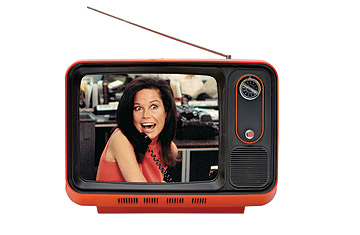
A television circa 1970
(2 of 3)
In a way, a list of the most influential shows misses the point of how people watch TV in the cable age: they watch networks--HGTV, ESPN, Nickelodeon--as much as they do shows. MTV, in the pre--Real World era, was the first network to teach viewers to watch this way. Quick-cut and compressed, music videos were not just a new way of selling music; they changed TV series (the pitch for Miami Vice was simply "MTV cops") and influenced movies (graduating directors like Spike Jonze, David Fincher and Michel Gondry). The best clips from MTV's all-video '80s heyday--from Michael Jackson to Talking Heads--capture the power of the music rather than replace it. MTV taught us to see with our ears and listen with our eyes.
THE COSBY SHOW 1984-92
Since Seinfeld, "hugging and learning" has come to stand for a certain kind of namby-pamby network comedy. But while there was hugging on The Cosby Show, Dr. Cliff Huxtable's love for his kids was filtered through the wry, no-guff sensibility that Bill Cosby developed on his comedy records. And the learning was literal, as the through line of the series was son Theo Huxtable's struggles with dyslexia. (The plot became poignant with the 1997 murder of Cosby's son Ennis, on whom Theo was based.) It's a sign of how quickly Cosby changed TV that in just a few years, it would be the standard that The Simpsons rebelled against. But by introducing TV viewers to upper-middle-class African Americans, the show gave us a realistic sitcom family that America actually could learn from.
THE SIMPSONS 1989-present
The Simpsons is the TV equivalent of Sgt. Pepper's Lonely Hearts Club Band (once parodied in the opening couch gag). After it came along, nothing was the same, and it established a generation's cultural references and sensibility. (Is there any situation without a usable Simpsons quote?) Starting out as a family cartoon, it grew a cast of hundreds that spanned celebrity (Rainier Wolfcastle), religion (the de-diddly-vout Flanders family), business (C. Montgomery Burns) and immigration (Apu). But maybe its best and favorite subject has been TV itself--"Teacher, mother, secret lover!" For all the series' ups and downs, it is still the Best. TV Show. Ever.
The 1990s
TWIN PEAKS 1990-91
David Lynch and Mark Frost made something really weird happen, and I'm not talking about Laura Palmer's murder, a dancing dwarf or a Log Lady. They turned prime-time TV into a giant indie art-house theater, and regular American channel surfers by the millions became its denizens. The story of a teen girl's death--and the pie-eating, deadpan-soliloquy-spouting FBI agent investigating it--carried on the theme from Lynch movies like Blue Velvet of sordid secrets and ancient horrors hidden behind a façade of wholesome Americana, proving that TV could equal or surpass film in its storytelling ambitions. Twin Peaks may have had the shelf life of a freshly poured cup of coffee, but it was damn fine nonetheless.
BEAVIS AND BUTT-HEAD 1993-97
To those who would call this MTV cartoon the boob tube at its most puerile, I have but one rejoinder: You said boob. This show's fart-knocking, frog-smashing anarchy alone might have put it on the list, but B&B was so much more. It was a surreal comedy ("I am the great Cornholio!"). It was one of TV's great inside critiques, peeling back the MTV fantasy of unattainable cool and personifying the sugar-buzzed idiot children who paid the channel's bills. Like creator Mike Judge's later Office Space, King of the Hill and Idiocracy, it was an unsparing, minutely observed and surprisingly good-hearted picture of consumer America. And to the list of great philosophical dialectics--good/evil, yin/yang--it added another: "That sucks"/ "That's cool." Beavis and Butt-head were always on the right side of that one.
THE SOPRANOS 1999-2007
To get a sense of how The Sopranos changed television, get a pen and make a list of the 20 best TV dramas before 1999. This Mafia saga showed just how complex and involving TV storytelling could be, inspiring an explosion of ambitious dramas on cable and off. In Tony Soprano's world, it wasn't the Mob that kept pulling you back into old, destructive patterns; it was your family--your controlling mother, your maddening wife, your feckless kids. Meanwhile, the big-F Family drama of the declining Mafia business offered popcorn entertainment alongside the deeper insights. Some fans may have hated the series' ending, but the fact that the show's last moments obsessed us demonstrates that America never stopped believin' in the power of this story.
The 2000s
SURVIVOR 2000-present
In reality TV, 90% of success is in the concept, and Survivor's remains the master equation: isolation + cash prize + hot-weather clothing = entertainment. Still, the 10% that is execution separates the best from the rest, and Survivor remains a constantly surprising and enthralling game, both socially and physically. Even after seven years, there's no clear single best way to win the political game: Is it better to be liked or respected, a master athlete or a master strategist? Whether or not it sheds any light on how people behave in real society, it remains the most engrossing example of how people really behave in the fake society of a high-pressure TV contest.
24 2001-present
It's tempting to discount this show after its admittedly terrible sixth season. But think back to how new and bracing the format that's now routine once was. Created before Sept. 11 and debuting just weeks after, 24 captured the country's edgy mood, and not just because it was about terrorism. With its breathless real-time format and multiscreens, 24 reflects the same information-overload media culture that gave us the zipper and screens within screens on cable news. The computers work a little too well, the Los Angeles traffic is suspiciously light, and Jack Bauer never has to take a leak, but Kiefer Sutherland gives Jack psychological weight in the most outlandish situations, racing against a ticking clock that tolls for us.
LOST 2004-present