

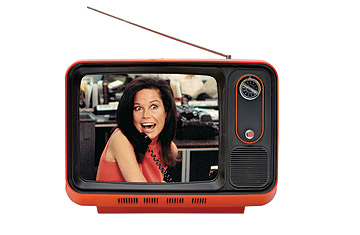
A television circa 1970
TV changed everything: the way we eat, the way we socialize, the way we feel about "reality." And almost more than any other medium, TV is always changing itself, reflecting current tastes and redirecting current tastes. On TIME.com this week, I've assembled a list of All-TIME 100 TV shows. It's meant to be not just a list of the greatest TV shows (though greatness was the price of admission) but also a survey of what TV can do--what this influential medium is, has been and is becoming. Here are some of the shows that were instrumental in changing TV and, therefore, changing us. Check out the rest at time.com/100tvshows and let the arguing begin.
The 1950s
I LOVE LUCY 1951-57
The sitcom that by now is almost a synonym for classic got that way by doing all the things that everyone at the time knew you weren't supposed to do. You couldn't have a female star who was both attractive and funny. You couldn't have her male lead be an urban Latino whose Cuban accent was thicker than a platter of ropa vieja. You couldn't build a story line around a (gasp!) pregnancy. Lucille Ball's contributions to TV's past are so obvious--Vitameatavegamin, the Tropicana Club, the slapstick routines--that it's better to note what this show says about today's future: sometimes the greatest sign of a future classic TV show is that it doesn't look like classic TV.
THE ERNIE KOVACS SHOW 1952-56
It's hard to imagine today that a half-century ago, TV was essentially the Internet: a wicked-cool invention that experimentalists would toy with just to see what crazy stuff they could make it do. Ernie Kovacs was the most innovative of TV's early mad scientists, using his comedy hour to spoof such then new creations as newscasts and ads and employing visual effects like upside-down pictures and tilted sets to appear to defy gravity. Comedy is lying done amusingly, and Kovacs knew that TV--which purported to show all but hid everything beyond the outline of the box--was a divine medium for lies. Kovacs would have been a natural in the age of YouTube; instead he made TV into HimTube.
The 1960s
THE SUPER BOWL (AND THE ADS) 1967-present
Devised as a condition of the merger of the AFL and NFL, the big game quickly became the kind of national communion that only TV could make: a daylong ritual and feast, an event that you watched because you needed to watch that thing that everyone was watching. And in 1984, with the debut of the Apple Macintosh ad, the game became a showcase for commercials and seemed to realize its true purpose: to be a massive, expensive, profligate tribute to the desires of America's consumers and to the full bellies of its warehouses. Showy, theatrical and full of talking animals, America's favorite short-film festival erases the boundary between shopping and entertainment, if there ever was one.
SESAME STREET 1969-present
Recognizing that television was going to be an electronic babysitter whether anyone liked it or not, Jim Henson and his Muppets provided a friendly haven that spoofed the media world kids were immersed in when the show wasn't on. From Kermit's news reports and Guy Smiley's game shows to "Elmo's World," Sesame Street has been filled with shows within shows, which take the commercial-TV world's come-ons and apply them to educational building blocks. Along the way, kids have learned about friendship, cooperation and even (through Mr. Hooper) death. The show's format has evolved over the years, but Sesame Street remains one of the savviest things ever brought to kids by the letters T and V.
The 1970s
THE MARY TYLER MOORE SHOW 1970-77
When the former Mrs. Rob Petrie made it, after all, onto her own sitcom as a single TV-news producer in Minneapolis, it was liberating for women on TV. But it also liberated TV for adults--of both sexes. Since Mary Richards was not a wife or a mom or (à la That Girl) a single gal defined mainly by her boyfriend, her self-titled sitcom was able to be a sophisticated show about grownups among other grownups, having grownup conversations. Moore made Mary into a fully realized person, iconic but fallible, competent but flappable ("Mr. Gra-a-a-ant!"), practical but romantic. Mary was human and strong enough to be laughed with and laughed at, and that was the kind of liberation that mattered most.
M*A*S*H 1972-83
Before M*A*S*H, the line between TV comedy and TV drama was as well demarcated as the DMZ between the two Koreas. This military-doctor comedy daringly combined zany humor--equal parts Marx Brothers slapstick and high-class wordplay--with dark drama, as when the war claimed the life of the base's first chief, Lieut. Colonel Henry Blake. (The show banned canned laughter in its operating-room scenes, presaging today's single-camera, laugh-track-free comedies.) Like many great shows, M*A*S*H stayed on the air a few years too long. But it proved that comedy could be serious, drama could be funny and both could cut like a scalpel.
AN AMERICAN FAMILY 1973
Before reality TV involved writers, immunity challenges and Paris Hilton, there was the Loud family. A public-television crew spent hundreds of hours in 1971 with a "typical" California family that proved to be anything but. Midway through the 12-hour cinema-verité series, paterfamilias and executive Bill Loud and wife Pat decided to split up. Their son Lance was casually introduced into the gay social scene of Greenwich Village in what would remain one of the most matter-of-fact treatments of a homosexual TV "character" for decades. The series raised what seem like--in the Big Brother and MySpace era--quaint questions about how taping reality alters reality. But ethically justifiable or not, it remains one of the greatest documents of American life, American media and the steadily vanishing distinctions between the two.
The 1980s
HILL STREET BLUES 1981-87
The Prisoner told serial stories before Hill Street, and The Fugitive hung a years-long chase on its otherwise self-contained episodes. But Steven Bochco's cop drama popularized serialized story arcs by proving that audiences would have the patience to stick with a story longer than 60 minutes. Hill Street demonstrated that a TV show could make a virtue of messiness with plots that didn't resolve neatly (or sometimes at all) and heroes who crossed ethical lines. Through conflicted Captain Furillo, abrasive Buntz and biting-prone Belker, Hill Street showed us imperfect cops delivering imperfect justice in an imperfect world--and did it to near perfection.
MTV 1981-92 era