

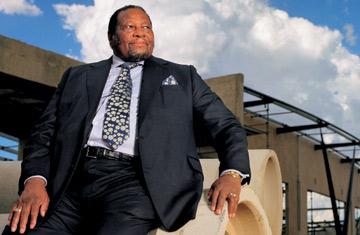
SETTING UP SHOP: Maponya, surveying the construction site of his mall, calls Soweto South Africa's strongest suburb
Sitting in his majestic home in northern Johannesburg, Richard Maponya tells a story. After building up a retail empire in the 1960s and 1970s, South Africa's first black tycoon fought for six years to become a racehorse owner when the Jockey Club of Southern Africa (now known as the National Horseracing Authority) was a white-only bastion. But once he was admitted (after a lengthy legal battle), he couldn't resist the temptation to needle his adversaries. "I called my first horse Another Color," the 80-year-old Maponya recalls. "On his third time out, Another Color came scorching home. At 400 m out, he hit the front, and the commentator was screaming: 'Another Color is coming up! Another Color is taking the lead! Another Color can't be caught! Another Color is winning!' To hear those words, to see what was happening — the black people in the crowd almost tore up the track. It was a riot. It was one of the most exciting days in my life."
As a rich black entrepreneur at a time when apartheid was meant to make such a thing impossible, Richard Maponya made his name, and his fortune, subverting the established narrative. Later this month, he will buck convention once again when, opposite the wooden shack used by Dark and Lovely Barbers on Old Potchefstroom Road and an abandoned shipping container that is the workshop for P. Maone Auto Electrical Repairs, he opens a $70 million, 700,000-sq.-ft. (65,000 sq m) steel-and-glass shopping mall in Soweto.
As with much of Maponya's life, the decision is as much political as financial. Soweto was created by the apartheid regime as a vast dormitory just over 19 miles (30 km) from Johannesburg city center (Soweto is short for South Western Township), where blacks would return each night to eat and sleep after another day of carefully controlled, low-paid work in the city. In the 1970s, this vast shanty town became a locus of revolution. After the end of apartheid, its tin shacks and dusty back alleys retained a reputation for poverty, unrest and crime. Maponya is undeterred. Poverty and violence are part of Soweto, he admits. But today so are smart bungalows (including one still owned by Maponya himself), private schools and hip restaurants. "I believe Soweto is the strongest suburb in the country," he says. "With an estimated 5 million people, it's one of the biggest cities in South Africa. And yet if people want to buy good clothes or furniture or electrical appliances, they have to get a taxi or train into Johannesburg." Those who fail to spot Soweto's nascent transformation from ghetto to the cradle of a new black middle class, says Maponya, are guilty of the same black-or-white short-sightedness that once held that "a black man was not capable of running a business."
The rise and rise of Richard Maponya is a lesson in how there is more than one way to fight a revolution. While the African National Congress (ANC) of Nelson Mandela and others confronted apartheid head on, Maponya undermined it from the inside. A 22-year-old teacher when apartheid first took hold in 1948, Maponya was offered a job as a stock taker in a clothes maker. He quickly proved a talented operator, winning a promotion for himself and the white manager, a Mr. Bolton, who took him on. A grateful Bolton began to sell offcuts and soiled cloth to Maponya, who set up his own tailor and sold clothing on credit. The authorities closed that business — despite the best efforts of South Africa's first black law firm, established by Mandela and Oliver Tambo — but not before Maponya had built enough capital to set up a dairy in Soweto.