

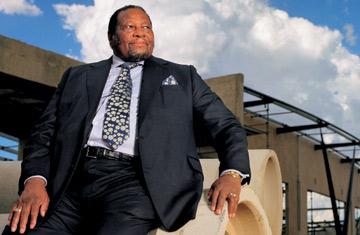
SETTING UP SHOP: Maponya, surveying the construction site of his mall, calls Soweto South Africa's strongest suburb
(2 of 2)
Since there was no electricity or refrigerators to keep perishables fresh, Maponya opened a distribution system with 100 bicycle delivery boys, who hauled milk to the families of Soweto exactly when they needed it. The dairy grew to a general provisions shop and, despite police raids and a constant battle to win licenses — for example, he needed a special license to sell soap on Sundays — a small conglomerate bloomed. By the mid-1970s, Maponya's businesses included a chain of general stores, a butcher shop, a restaurant, a Coca-Cola plant, filling stations and a GM and BMW car dealership. "Richard Maponya is the real deal," says Michael Spicer, ceo of South Africa's Business Leadership forum, which advises government and big business on policy. "He cut his teeth at a time when it was exceptionally difficult for black Africans, and he did not do it in any facilitated way. Richard was black and rich and proud — and he did it himself. That made him one of the first black icons, a role model when there were practically none." The Little Black Book, an annual rundown of South African business leaders, calls him "the father of black retail."
Through it all, Maponya was always careful to stay on the right side of the law, even if it meant fudging the truth. Arrested on suspicion of funding ANC student fighters, a charge of which he now admits he was guilty, he escaped a sentence by claiming he made payments under duress. But Maponya developed a taste for provocation and pushing the system to its limits. He bought a home in an affluent Johannesburg suburb when he was meant to be confined to the townships. At the Jockey Club, he dressed his (white) jockeys in black, gold and green — the colors of the ANC.
Maponya's relationship with the ANC was not always smooth, however. One of Maponya's few fellow black entrepreneurs was Ntatho Motlana, a doctor who began South Africa's first private black hospitals before branching into telecommunications and media. Motlana says that all through the apartheid years, the ANC was split on whether being involved in business supported apartheid and was a betrayal. "Some thought being involved in business meant not being involved in the struggle," adds Motlana, 82. "We were saying that if we were independent, if we made money for ourselves, that was part of the movement. And today you can see the effect of people like Richard was powerful. It set off a whole chain of events that said to people: 'You are going to pull yourself out of poverty.'"
Maponya himself says that, while others fought the system, he simply worked it — to make it work for him, and Soweto. "Nelson and the others, they sacrificed themselves, their jobs and their lives for our freedom. My contribution was small. I wasn't locked up. But I was undermining the regime. I was exposing them. I was making the statement that, given a chance, a black man could become as successful as a white man."
That mission — upsetting the status quo — continues. "The new mall is about saying that a mall in Soweto can be as 21st century as anywhere in the world." As does his enthusiasm for getting up people's noses. After his win with Another Color, Maponya went on to become a breeder, at one time owning the biggest stable in South Africa. And the name of his stud? Maponya laughs. "Black Charger."