

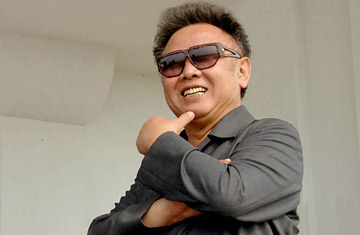
North Korean leader Kim Jong Il, viewing farms and fields during his visit to the Sinam Cooperative Farm in Ryongchon County, North Korea.
In the heart of Pyongyang stands a gray, six-story concrete building that is not unlike thousands of others in the dreary communist capital, except that this one is protected around the clock by uniformed soldiers. The building is known as Bureau 39, and it is the headquarters of a worldwide criminal enterprise that is owned, overseen and operated by the government of North Korea.
Through a state-owned conglomerate called Daesong, Bureau 39 oversees export businesses owned and run by the North Korean government--mainly textile and other light-manufacturing factories and some mines. But Bureau 39 also houses another, shadowy directorate that oversees illicit enterprises ranging from drug trafficking to money laundering, claim a dozen current and former government officials in the U.S. and East Asia as well as academic researchers and private-sector investigators interviewed by TIME. Those illegal activities earn, by some estimates--including one by the State Department's former point man on the issue--about $1 billion a year for the senior Pyongyang leadership. How important is that business to the regime? Consider that in 2005, all of North Korea's legitimate exports totaled $1.7 billion, according to a CIA estimate.
Sheena Chestnut, a researcher at Harvard University and the author of a forthcoming article in International Security on what she calls the "Sopranos State," says, "Although multiple entities within the North Korean system appear to participate in the organization and implementation of criminal activity, the coordination of the system--and financial control--appear to be exercised at the top by Bureau 39." Chestnut and diplomatic and intelligence sources in East Asia say Bureau 39 houses the personal financial advisers of North Korean dictator Kim Jong Il and his top deputies. "Some rich people use Goldman Sachs or UBS to manage their money," says a South Korean law-enforcement official. "Kim and his friends use Bureau 39." (Like many other people interviewed for this story, he would speak only on condition of anonymity.)
A TIME investigation found that Kim's criminal businesses not only stretch across Asia but also have managed to gain footholds in Russia, Europe and the U.S. Among the regime's illicit activities are the production and trafficking of opium and heroin to dealers around the world, the manufacture and sale of billions of counterfeit cigarettes and the production of tens of millions of dollars in forged U.S. currency sophisticated enough to evade detection by U.S. banks. In many cases, the transactions are conducted not by rogue gangsters but by North Korean government officials, including members of the country's diplomatic corps stationed overseas. (North Korean government officials did not respond to numerous requests for comment for this article.)
The U.S. has tried to thwart North Korea's criminal activities for years. In 2005 Washington earned its biggest success when it managed to freeze $25 million of the regime's funds in Banco Delta Asia, a bank in Chinese-controlled Macau, near Hong Kong. At least half that money had been generated from the North's Mafia-style businesses. But one month ago, the U.S. returned the money to its account holders, a diplomatic chip in what the U.S. and its partners in the six-party negotiations with North Korea believe is a more important game: getting Kim to give up his country's nuclear-weapons program. Shortly afterward, the North agreed to allow inspectors from the International Atomic Energy Agency to witness the shutdown of its plutonium reactor in Yongbyon. On June 21, U.S. diplomat Christopher Hill met with North Korean officials in Pyongyang--the highest-level visit to the North since 2000. The trip was a sign of the Bush Administration's drive to strike a disarmament deal with the Kim regime, which President Bush once named a member of the "axis of evil." The Administration is reportedly considering a formal end to the Korean War if the disarmament process succeeds. A former State Department official says Washington's policy toward Pyongyang is "speak softly--and hope for the best."
But even if Pyongyang agrees to disarm, there's little reason to believe that the regime will abandon its nefarious business dealings. By keeping Kim's top military and security officials happy, such lucrative enterprises help the dictator maintain his grip on power and resist pressure to open up the North's broken, Stalinist economy. David Asher, who led the State Department's delegation to the six-party talks from 2001 to 2005 and was the chief monitor of North Korea's illicit activities, says, "Given that North Korea and its élite need hard currency, we can expect them to continue criminal activity to earn that money. The major problems associated with it will almost certainly continue."
According to Asher, the big worry among U.S. and Asian intelligence officials is that "the [North]'s growing ties to organized-crime groups and illicit shipping networks could be used to facilitate weapons-of-mass-destruction shipments." Later this year, the U.S. is expected to go to trial in New Jersey on a case targeting alleged members of a Chinese organized-crime gang accused of moving counterfeit currency, illegal narcotics and contraband cigarettes from North Korea into the U.S.--in addition to at least $1 million in illegal weapons such as pistols, machine guns and rocket launchers. The question that worries officials from Washington to Tokyo to Seoul is, Asher says, "What could be next?"
BELLFLOWERS IN BLOOM
FOR MOST OF THE YEAR, KIM IN-HO, 42, A defector from North Korea who now lives in Seoul, was an ordinary worker in a state-owned textile factory in Haesan City in Yangang province, not far from the border with China. Yet each summer, Kim and his colleagues left the looms and were sent to nearby farms to collect the year's harvest. It wasn't food they were gathering, he says, although North Korea has chronic food shortages, but "white bellflowers," or poppies, the vital feedstock for opium and heroin processing. North Korean poppies are the starting point of an elaborate chain of production whose result ends up on the streets of Russia, China and beyond.
In most countries, the narcotics business is conducted by private organizations in the shadows as corrupt officials look the other way in return for payments. In North Korea, the opposite is true. "The government not only knows about it--it organizes it," Kim says. "The money [from the sale of heroin abroad] goes to the government."