

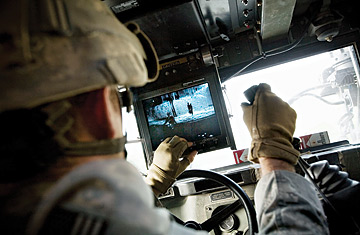
View from inside a Humvee during a patrol in the Sunni area of Gazaliya with Delta Company 2-12 CAV 2nd BT from JSS Thrasher Humvee. Recently even the new Humvees are equipped with an external video cameras.
Saif Abdallah says his inventions have helped kill or maim scores, possibly hundreds, of Americans. For more than four years, he has been developing remote-control devices that Sunni insurgents use to detonate improvised explosive devices (IEDS), the roadside bombs that are the No. 1 killer of U.S. soldiers in Iraq. The only time he ever felt a pang of regret was in the spring of 2006, when he heard that the Pentagon, in a bid to fight the growing IED menace, had roped in a team of scientists from the Massachusetts Institute of Technology. Abdallah, an electronics engineer by training, once dreamed of studying for a Ph.D. there. "I thought to myself, If my life had gone differently, who knows? I might have been on that team," he says, his eyes widening as he imagines that now impossible scenario. Then he shrugs. "God decided I should be on the other side."
Thin-voiced and thickly bespectacled, Abdallah, 28, fits every geek stereotype, right down to the acne and the flash drive on his key chain. His laboratory is a workbench in the bedroom of his Baghdad home. He says his tools are primitive--soldering irons, old printed circuit boards, discarded TV remotes and other bits of electronic detritus. But he has a talent for fashioning instruments of death from such dreck, turning an old toy walkie-talkie into a trigger for an explosion 100 yards away or programming a washing-machine timer to set off an IED two hours later. Such capacity for destruction makes him invaluable to the disparate groups that make up the Sunni insurgency, including al-Qaeda. "In our circle, everyone has heard of him," says the commander of one rebel group, al-Nasr Salahdin.
Sectarian outrages like the June 13 attack on the holy Shi'ite shrine in Samarra--the same site that insurgents blew up last February-- have plunged Iraq into civil war. But it is brainy operatives like Abdallah who pose the most consistently lethal threat to U.S. forces. When we met for our second encounter in 15 months, he didn't seem especially worried that a massive U.S.-Iraqi security crackdown had been under way in Baghdad for the past four months--and that one of its aims was to break the back of the IED industry and roll up people like him. (Abdallah was introduced to TIME through Sunni insurgent contacts, but he did not provide his real name or reveal where he lives.) Iraqi and American officials say they have shut down dozens of bomb factories, arrested nearly 18,000 insurgents and killed more than 3,000 others. But the only metric that matters to Abdallah is the number of Americans killed. By that measure, he figures his side is winning. U.S. casualties have risen every month since February, just after the start of President Bush's surge strategy to quell the bloody Shi'ite-Sunni war. At least 230 service personnel were killed in April and May, making it the deadliest two-month period for U.S. troops since the war began.
It is indicative of the U.S.'s inability to crush the insurgency that commanders are trying to find ways to split it. The military is urging Sunni nationalist groups to take up arms against their former al-Qaeda allies and has begun supplying some of them with weapons. In the immediate future, however, such efforts are unlikely to protect U.S. troops from an increasingly sophisticated and tenacious enemy--and may even put Americans at greater risk. A TIME investigation reveals that militant groups have responded to the U.S. surge with a big push of their own, unleashing a flurry of new or rarely used tactics and innovations designed to maximize the death toll. Their most potent weapons are the roadside bombs being fashioned by men like Abdallah, which now account for roughly 80% of U.S. deaths, up from 50% at the start of the year. "People are calling me all the time, asking for new ways to ..." Abdallah says, pressing down his right thumb on an imaginary remote control, and adds, "... Boom!"
The military's current security push in Baghdad, known to Iraqis as Operation Fard al-Qanoon, or Imposing Law, has elicited opposite responses from Iraq's two warring sects. Shi'ite militias like the Mahdi Army have decided to lie low; their leaders went underground or on vacation to Iran. Sunni groups, especially al-Qaeda's Iraqi wing, have girded for battle. Groups associated with the Islamic State of Iraq, an umbrella organization controlled by al-Qaeda, began to confer with one another and with other Sunni groups. "The first thing we realized is that we would need lots of IEDS and car bombs," says al-Nasr Salahdin's field commander, who was involved in some of the discussions. "Once the Americans were fully deployed, it would be hard to move bombs around, so we had to make them quickly and distribute them."
Some insurgent commanders fell back on tactics that worked before, such as moving their operations into areas where there are relatively few U.S. troops. Al-Qaeda elements driven out of Anbar province by the Marines and a coalition of local tribes began to cluster in Diyala. In recent weeks, bombers have struck even farther north, in Mosul, Kirkuk and long-peaceful Kurdistan. But most groups remained in Baghdad and even called in reinforcements. Many al-Qaeda fighters moved from Anbar to the capital, and the Islamic Army, the largest Iraqi insurgent group, called on its fighters to rally there for a cataclysmic showdown with U.S. and Iraqi troops. They began to attack new targets, like U.S. helicopters and important bridges that connect Baghdad to the rest of the country. "These were all new kinds of attacks, and there were so many of them, it was hard to keep track," says a Western official in Baghdad, who asked not to be identified because he is not authorized to speak with the media. "The message from al-Qaeda was, You do your surge, we'll do ours."
The insurgents have upgraded their weaponry. A field commander of the Islamic Army told me his men had produced "hundreds" of huge IEDs more destructive than the armor-piercing bombs that, the U.S. believes, are being smuggled into Iraq from Iran. He said the new bombs are being buried deep in dirt tracks on the outskirts of Baghdad that are likely to be used by American patrols. Some of the bombs are planted in sewers and irrigation culverts; their concrete lining would direct most of the force of an explosion upward--enough to "turn an Abrams tank into an airplane."