

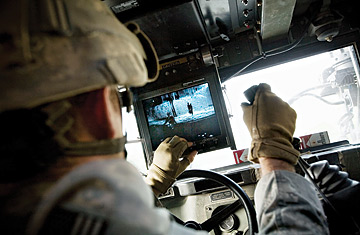
View from inside a Humvee during a patrol in the Sunni area of Gazaliya with Delta Company 2-12 CAV 2nd BT from JSS Thrasher Humvee. Recently even the new Humvees are equipped with an external video cameras.
(2 of 2)
Such claims are typically greeted with skepticism by U.S. commanders. There have been no reports of any Abrams tanks being taken out by an IED since the start of the security crackdown. Still, there's anecdotal evidence that deep-buried bombs are having a devastating effect on other heavily armored American vehicles, even those designed to withstand large explosions. The Islamic Army isn't alone in employing this technique. In April a video posted on the Internet by the Islamic State of Iraq showed several Cougars and Nyala RG-31s--"mine protected" troop carriers--being blown up by IEDs. The video showed militants using deep-buried explosives to target vehicles meant to find and disable roadside bombs, like the Buffalo counter-IED vehicle and the Meerkat mine detector. The video's ominous title: "Hunting the Minesweepers."
Insurgent groups have had four years' practice in making and camouflaging IEDs. The bombs are especially hard to detect in crowded urban areas full of potholes, drains and sewers. The abundance of garbage on Baghdad's streets can defeat devices meant to locate bombs in relatively uncluttered locales. A discarded refrigerator on the curb could be packed with explosives. Every parked car is potentially a vehicle-borne IED (military jargon for a car bomb). Built-up areas also offer hiding places for those who plant the explosives and set them off. Abdallah says he has been asked to make trigger devices that work from as close as 75 feet away.
While urban settings undermine the U.S. military's high-tech tools, they suit the militants' low cunning. One common tactic is to hide bombs in loose rubble, then stack human feces on top; soldiers are less likely to investigate too closely. Other tactics are more complex. In some neighborhoods militants use snipers to lure soldiers toward IEDs. The bombs are hidden in places where the troops would tend to take cover when under fire--behind a hedge or a pile of bricks. Senior Iraqi police officials report that militants hide bombs in human cadavers, dumping them on the street and detonating them when a military or police patrol stops for an inspection. "They know that we can't just leave a body to rot in the street," a police official says. "They are counting on us to do the right thing, then hit us when we do."
American soldiers have paid dearly for their commitment to their fallen comrades. On Memorial Day, six soldiers were killed in roadside bombings in Diyala province, north of Baghdad, as they rushed to the crash site of a downed OH-58D Kiowa scout helicopter. The two crewmen had died in the crash, but the militants who brought the helicopter down, apparently anticipating that a rescue would be attempted, had set up an IED ambush. A more sophisticated operation was mounted on May 12 by Islamic State fighters in rural Mahmudiyah, south of Baghdad. They attacked a U.S. patrol, killing five soldiers and capturing three others. They then planted IEDs in the adjoining palm groves, correctly believing that the military would launch a massive manhunt. One soldier was killed and three others were injured when an IED went off in a field. Two weeks later, the Islamic State claimed in a video that it had killed the three captured soldiers. Other patrols in Mahmudiyah have been hit by attacks involving roadside bombs followed by mortars and small-arms fire.
In response, the U.S. is stepping up its efforts to thwart the growing potency of IEDs. The Pentagon has formed a task force, the Joint IED Defeat Organization (JIEDDO). Its more than 500 workers include "red teams," who spend their days trying to think like insurgents, hoping to stay ahead of them. JIEDDO has spent more than $5 billion in the past three years and has a $4 billion budget for the current year. The Pentagon says its spending yields tangible results. "Three years ago, practically every IED incident created some kind of casualty," says Brigadier General Anthony Tata, JIEDDO's deputy director of operations. "Now the enemy must create six incidents to create a casualty of some variety." But top commanders know that roadside bombs can't really be defeated by gadgetry. At a conference on roadside bombs, Brigadier General Joe Ramirez Jr., deputy commanding general of the Combined Arms Training Center at Fort Leavenworth, Kans., said, "For every move we make, the enemy makes three ... The enemy changes techniques, tactics and procedures every two to three weeks."
General Richard Cody, Army vice chief of staff, told Congress in April that finding and defusing roadside bombs is not a long-term solution. "The real issue about defeating IEDs ... is not at the point of impact," he said. "We have to go and find the guys making them and kill them. We have to find the guys who are getting ready to place them and kill them. That's how you defeat IEDs."
Abdallah concurs. "They are not going to defeat me with technology," he says. "If they want to get rid of IEDs, they have to kill me and everyone like me." If they don't, Abdallah is only going to get better at what he does, with deadly consequences for American soldiers. The terrorism geek has come a long way since our previous meeting. To demonstrate his prowess, he produces a black briefcase-size device with Japanese markings and flicks a switch on its side. He claims that the device is similar to those used by U.S. troops to block cellular signals around IEDs and disable bombs wired to detonate with a cell-phone call. Abdallah says he was given the device by a Saudi militant who asked him to find a way around jamming signals. He invites the four people in the room to try to use their cell phones; none of us can get a signal. "I've jammed you all," he says, tapping the black device. But his own phone, a cheap Nokia, shows a full-strength signal. "I made a few small changes inside," he says, holding up the phone and grinning triumphantly. "It took me just one day to figure it out." It is grim evidence of the perils facing the U.S. in Iraq that men like Abdallah can still make killing Americans look easy.