

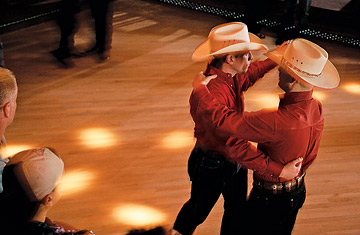
Scott Szelipajlo and Corey Fleming take part in western dance lessons at the Round-Up Saloon in Dallas, Texas.
(2 of 2)
Oakley won his seat in 2001. Born to a meatpacking family in tiny Davis, Okla., he came to Dallas 25 years ago, and his little contracting company grew successful in part by building many of the gay venues along Cedar Springs Road. Not that Oakley was a gay activist; he spent most of his time courting business interests, and he hardly ever mentioned his sexuality, although he has been out of the closet for 30 of his 54 years.
Sheriff Lupe Valdez, 59, was a bit more open. "When I met with any group asking for their support, I would say, 'I have 24 years of law-enforcement [experience]. I have international experience. I have military experience. I'm a lesbian ...'" she recalls. "And somebody would say, 'Did she say she's a lesbian?' You know, it was just part of who I am, and it wasn't hidden."
For most of their adult lives, Oakley and Valdez never had to pretend they were straight, and for the most part, Dallas didn't care--or didn't ask. But as they have assumed more powerful roles, their sexuality has occasionally seemed like an encumbrance. Oakley has woken up at 4 a.m. worried that a single "tacky mail piece" emphasizing his sexuality could keep him from the mayor's office. He had had one of those nights when we met for breakfast, and he spent the meal nervously doodling on napkins and periodically asking me to turn my recorder off. Oakley's fears aren't entirely irrational. A creepy robotic caller left messages across the city on election day: "Ed Oakley has a radical gay agenda for Dallas ... Dallas needs strong conservative leadership." It's unclear who financed the messages, but they didn't keep Oakley from making the runoff. Dallas district clerk Gary Fitzsimmons, who was targeted during his 2006 campaign with a robo-call mentioning his homosexuality, says he thinks the message ended up helping him. "At least 100,000 houses received that call, but I think it backfired. I had elderly couples coming up to me saying it wasn't fair." And the call probably prodded gays to vote.
The trick for Oakley will be to win over African Americans whose churches may preach against gay equality. Oakley will lose if black voters stay home. But even if he does lose, the culture war in Dallas is, arguably, over. Cosmopolites of various stripes--new-rich arrivistes, coastal transplants, the arts community--control not only the city but much of the suburban county. To get a feel of old Dallas, the one I remember from the '80s, you now have to leave Dallas entirely--for the exurbs.