

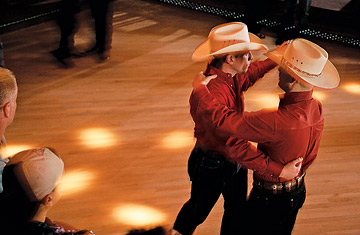
Scott Szelipajlo and Corey Fleming take part in western dance lessons at the Round-Up Saloon in Dallas, Texas.
When I was a kid in Arkansas in the 1980s, we viewed Dallas with something approaching reverence. Mine was a fairly conservative family, aspirational. We passionately golfed and occasionally visited Neiman Marcus, the Dallas clothier that taught the South how to wear Versace and an air of profligacy. I wanted to drive a Mercedes and order bourbon and branch the way J.R. Ewing did. I wanted to go out with a Cowboys cheerleader with marcelled blond hair. The summer I was 13, Ronald Reagan was renominated in Dallas, and I signed up to be a young volunteer.
I've changed quite a bit, trading movement conservatism for gay libertarianism, and Dallas would like you to know that it has changed too. The Dallas Convention & Visitors Bureau operates a website proclaiming that "Dallas truly is the most liberal city in Texas!" It's wild exaggeration--Austin, home of the main UT campus and the D.A. prosecuting Tom DeLay, has valid claim to the title--but Democrats now occupy not only the Dallas mayor's office and most city-council seats (which are only technically nonpartisan) but also 57 of 84 offices in sprawling, once right-wing Dallas County.
Last fall, just six years after Dick Cheney left the Dallas office of Halliburton for Washington, Democrats swept every county-wide contested race. And on May 12, Dallas sent an openly gay candidate into next month's mayoral runoff. If city councilman Ed Oakley defeats former Turner Construction CEO Tom Leppert, Dallas will become the first big U.S. city to elect a gay mayor. Dallas would join Berlin and Paris as major cities led by gays. Wait--Dallas?
There are lots of reasons for Dallas' political shift, some peculiar to last year's mid-terms. Nearly 40,000 Dallas Republicans stayed home last fall, according to county G.O.P. chairman Kenn George, because they were angry about federal spending, immigration policy and the way the war was being conducted. Many of those who did vote were simply looking for a D next to a name, any name. "There were people that had been in office that really were probably good people on the Republican side," says Oakley, a Democrat. "It didn't matter."
Even so, the demographic trends here don't favor the Republicans. George (who ran for land commissioner in 2002 as "a lifelong friend of President George W. Bush") pointedly noted that the President, a longtime Texan who is expected to move to Dallas and build his library here after he leaves the White House, carried the county with just 50.1% of the vote in 2004. Dallas has long had a large African-American population, and now nearly a third of Dallas County is Latino.
But gays have played an important, less noticed role in Dallas' evolution. Over the past decade, a large and politically powerful lesbian and gay community has emerged. Both the Dallas sheriff and the county judge--an Old West title meaning chairman of the county commissioners--are openly gay. The district clerk is gay too, and Dallas is home to what is said to be the largest gay church in the world, the Cathedral of Hope, which has 3,500 members, a full choir, a violinist and long-stemmed roses in the bathroom. Dallas' fund-raising dinner for the Human Rights Campaign, the Washington-based gay group, is the largest in the nation, drawing 3,300 and raising more than $1 million for HRC and local gay organizations. And according to the gay group Lambda Legal, Dallas' is the only school district in Texas that includes teachers in its antidiscrimination policies.
Just in the past couple of weeks, in an easy-to-overread but highly poetic coincidence, DeLay's political-action committee, Americans for a Republican Majority, told the Federal Election Commission that it had closed. Days later, a Democratic group called the Texas Values in Action Coalition (TEXVAC)--founded by three gay Dallas liberals in 2005--staged a self-congratulatory dinner in once solidly Republican north Dallas. At least 500 people attended, raising $200,000 for TEXVAC, which was instrumental in last fall's Democratic victories. ("We owe it all to these three remarkable young men," former Mayor Ron Kirk said of TEXVAC's founders during the dinner.)
So how gay is Dallas? Gay population figures are difficult to estimate because even accepting communities have a closet. But according to the Williams Institute, a gay think tank at UCLA, Dallas has the ninth largest concentration of same-sex couples in the nation. As the Dallas visitors bureau gurgles, "[Dallas] has left behind stereotypes of big-haired women and rowdy cowboys--that is, unless you count sassy drag queens and strapping gay rodeo champs."
This is not the Texas of the American imagination. Or is it? Ensorcelled by strivers and status, Dallas has always tried hard to be sophisticated. And the city knows a mathematical equation about American city life: urban sophistication requires gay civilization. Gays have gentrified once crumbling neighborhoods like Oak Lawn in Dallas; many gays have relocated to the city to work at companies like American Airlines that have a significant gay customer base.
The city is building a $275 million Center for the Performing Arts downtown that will feature a theater designed by Ur-Euro architect Rem Koolhaas; when Dallas broke ground on a bridge across the Trinity River in 2005, it was working not from, say, a practical Army Corps plan but from a soaring design by the Spaniard Santiago Calatrava. It would be silly to suggest these projects were built with gays in mind--the Koolhaas theater is largely funded by Republicans Charles and Dee Wyly--but the architectural ornamentation does help explain why Dallas is more appealing to gays than, say, dowdy Austin. Gays who felt insecure in small Southwestern and Southern towns like the one where I grew up have long been drawn to this city of great yearning and ostentation. It was in one of Dallas' busy gay bars, ironically called J.R.'s, that I saw a T shirt that has become popular in a not totally ironic way. KEEP DALLAS PRETENTIOUS, it said. SUPPORT YOUR OWN MATERIALISM. (It's an answer to the capital's unofficial slogan, "Keep Austin weird.")
The story of Dallas' transformation properly begins in 1991, coincidentally the same year Dallas went off the air. That March, a judge ruled the city's representation should be recut into 14 city-council seats in order to ensure more minority representation. Blacks, Hispanics and gays benefited from the decentralization; the first openly gay city-council member was elected in 1993.