

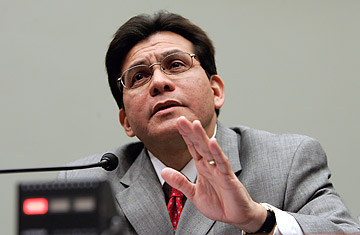
U.S. Attorney General Alberto Gonzales testifies during a House Judiciary Committee hearing on Capitol Hill, May 10, 2007.
It takes a lot to get mild-mannered Attorney General Alberto Gonzales hot under the collar. That's why it was telling when word went out to his top aides in February that something had set him off. "The Attorney General is extremely upset with the stories on the U.S. Attorneys this morning," his spokesman Brian Roehrkasse wrote in an e-mail. The papers that day were full of news about the testimony that his deputy Paul McNulty had given to the Senate Judiciary Committee regarding the firing last year of eight U.S. Attorneys. Gonzales had previously suggested that all of them had been dismissed for poor performance, but McNulty allowed that at least one of them, Bud Cummins of the Eastern District of Arkansas, had been removed to make room for Tim Griffin, a Karl Rove protégé who had headed the opposition-research operation at the Republican National Committee. Gonzales was upset, his former chief of staff Kyle Sampson has told congressional investigators, that McNulty's revelation put "in the public sphere" the uncomfortable fact that the White House helped engineer the dismissal.
That went right to the real question that is being exposed as the controversy over last year's purge of U.S. Attorneys enters its fifth month: Did Gonzales, the consummate George Bush loyalist, politicize the workings of one of the most sensitive and traditionally independent agencies in government, the Department of Justice (DOJ)? While it's true the President has always picked an ally to run the department and populated its upper echelons with political appointees, the bureaucracy has fiercely guarded a unique and proud tradition of insulating from partisanship those who are charged with making sure that the laws of this country are fairly and evenly enforced. Though every Attorney General has faced pressure to use the DOJ's awesome power to punish the President's enemies and help his allies, critics inside the department and out say Gonzales has yielded to it more than most.
At a minimum, he has handed an extraordinary amount of authority, particularly over hiring and firing, to young, lightly credentialed and fiercely partisan aides who appear to have put politics ahead of the public interest. One of those aides was Sampson, 37, who assembled the list of U.S. Attorneys to be fired and who was himself bucking for a U.S. Attorney post, despite the fact that he had limited experience as a prosecutor. The other was Monica Goodling, 33, the department's White House liaison, the product of a law school where more than half her graduating class flunked the bar exam on the first attempt. A March 2006 memo signed by Gonzales delegated authority to the two of them over the hiring and firing of 135 non--civil service Justice Department staffers. Amid the scandal, both have resigned.
What Gonzales' team wanted in U.S. Attorneys, according to an e-mail that Sampson sent to the White House, was "loyal Bushies." And thanks to a provision they quietly slipped into last year's reauthorization of the Patriot Act, they were able to put their candidates in without going through the customary route of Senate confirmation.
Seven of the eight fired had one thing in common: they were in districts where there were close electoral contests. In New Mexico, for instance, David Iglesias was fired after two Republican lawmakers, Senator Pete Domenici and Congresswoman Heather Wilson--who was in a tight House race-- called him to inquire about a corruption investigation that could have hurt Wilson's Democratic opponent. Iglesias claims Domenici went so far as to ask whether charges would be filed before the November balloting. A few weeks later, after complaints from Rove reached Sampson, Iglesias' name was added to the list of U.S. Attorneys to be fired. When Iglesias was booted with the others on Dec. 7, William Kelley, a deputy to then White House counsel Harriet Miers, sent Sampson an e-mail saying that Domenici's chief of staff "is happy as a clam" about the move. A week later Sampson replied that "Domenici is going to send over names [for a replacement] tomorrow (not even waiting for Iglesias's body to cool)." Both Domenici and Wilson have denied acting improperly.
At the center of all the intrigue is the role that Rove might have played in the department's decisions. The White House says an untold number of e-mails related to the firings may have gone missing, thanks to the fact that Rove and his aides were using separate e-mail accounts at the Republican National Committee, possibly violating the law. So the Senate Judiciary Committee subpoenaed Gonzales to hand over any e-mails to, from or copied to the President's chief political strategist that relate to the investigation. According to a Justice Department "privileged log" of e-mails not yet given Congress, Rove was among the recipients of at least one relevant message that showed up in Sampson's Inbox from Scott Jennings, a special assistant to the President. Dated Feb. 28--the day Iglesias went public with his accusation that Domenici and Wilson had improperly inquired about the corruption investigation--it is described in the log as: "Discussion re: telephone call received from Sen. Domenici's COS [chief of staff] re: Iglesias press conference."
Meanwhile, it increasingly appears that Gonzales' underlings were taking political affiliation into account even when considering applicants for entry-level career positions that are supposed to be filled strictly on merit. As recently as March, Jeffrey Taylor, the top federal prosecutor for the District of Columbia, sources say, wanted to know why it was taking so long to hire a lawyer he had recruited. The answer he got from Goodling was that the candidate had been deemed unacceptable because the applicant appeared to be a Democrat. Goodling's lawyer refused to comment, citing Goodling's right to remain silent.
With every new revelation, the calls by lawmakers of both parties for Gonzales' resignation have grown louder. But Bush has been unwilling to cut him loose, a testament to the intense personal bond that he and Gonzales have felt for each other since the newly elected Texas Governor plucked the Harvard-educated son of migrant farm workers from a prestigious Houston law firm to become his counsel. Every one of the increasingly powerful jobs Gonzales has held since then--Texas secretary of state, state supreme court justice and White House counsel--has been bestowed on him by Bush. When he has been asked how running a 110,000-person department was different from his job as White House counsel, Gonzales has replied, balefully, "Well, I miss the President. I don't get to see him as often as I did when I was in the White House."