

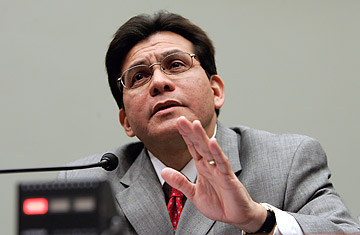
U.S. Attorney General Alberto Gonzales testifies during a House Judiciary Committee hearing on Capitol Hill, May 10, 2007.
(2 of 2)
It is not unusual or necessarily undesirable for a President to put a loyalist in the nation's top law-enforcement job. John Kennedy, at his father's insistence, gave the post to his brother. When Robert Kennedy resisted, the newly elected President told him that he needed someone he could talk to in a Cabinet in which everyone else was a stranger. Gonzales has argued that his friendship with Bush makes him more effective as an Attorney General. "When a friend tells someone, 'No, you can't do that,' you're much more likely to listen to that and to accept it," Gonzales told the National Journal last year. "I've got that kind of relationship with the President." Another advantage of putting an ally in the post is knowing that he or she will pursue the priorities upon which the President was elected, just as a Pentagon chief or Secretary of State is expected to do. "You want the Attorney General to be politically accountable," says Orin Kerr, a legal scholar who teaches at the George Washington University Law School. "Imagine if a President is elected to pursue terrorism cases, and the A.G. decides, 'I don't like terrorism cases. I want to pursue bank fraud cases.'"
But critics say, under Bush, the connnection between the White House and Justice became so close that it had to be formalized. When Gonzales testified last month before the Senate Judiciary Committee, Democratic Senator Sheldon Whitehouse, a former U.S. Attorney for Rhode Island, produced documents and charts showing that under Bill Clinton, a policy was carried out that allowed only four people at the White House--the President, Vice President, White House counsel and deputy counsel--to discuss pending criminal cases with anyone at Justice and only with the top three officials of the department. Under Bush, that policy was loosened so that 417 White House staffers had that authority and could contact more than 30 people at Justice.
Justice Department officials say that changes were made after 9/11 to improve coordination of investigations in cases regarding national security and that contacts occur only on those cases. But there were no such issues at stake when the U.S. Attorney for Seattle, John McKay, was making the case to be nominated for a federal judgeship last August. McKay claims the first question he got from Miers was "why Republicans in the state of Washington would be angry with me." The answer, McKay believed, was that during a very tight Governor's race in 2004, he had decided there was no merit to voter-fraud accusations that Republicans had lodged against the Democrats.
McKay also believes his refusal to prosecute those claims is why he wound up on the list of U.S. Attorneys who were fired. "We expected to be supported by people in Washington, D.C., when we make tough decisions like that," McKay told Tim Russert in March on Meet the Press. McKay had every reason to be surprised by his dismissal. Former Deputy Attorney General James Comey, the tough-minded Bush appointee who supervised McKay at the Justice Department from 2003 to 2005, has described him as a strong performer. "I was inspired by him," Comey told a House Judiciary subcommittee. He had similar praise for most of the others who were fired. "One of the best," he said of Paul Charlton of Arizona. "Straight as the Nevada highway and a fired-up guy ... He was loved in that community," of Daniel Bogden in Las Vegas. "Very straight, very able," Comey said of Iglesias in New Mexico.
As the U.S. Attorney scandal unfolds, it may point to some things that are much more long lasting: a political transformation of the department from the bottom rungs up, including nonpolitical career jobs. Nowhere has that been more evident than in the civil rights division, which has historically been the most fiercely apolitical division in the department and where voting-rights cases, among other things, are handled. In 2003, the Administration changed the rules to abolish the hiring committees made up of veteran career lawyers and gave that job instead to political appointees. Last year the Boston Globe, analyzing hiring data it had obtained under the Freedom of Information Act, reported that the ranks of the division were being filled with lawyers who had strong conservative credentials but little civil rights experience.
That has shown up in the direction the division has taken, says Joseph Rich at the Lawyers' Committee for Civil Rights Under the Law. Rich, a former chief of the voting section in the civil rights division who worked at the Justice Department for 35 years before leaving in 2005, says that from 2001 to 2006, no voting discrimination cases were brought on behalf of African-American or Native American voters. Instead, he alleges, U.S. Attorneys were told to give priority to voter-fraud cases, which civil rights groups have long contended are actually meant to depress voter turnout in minority communities.
"In all the years I was in the Department of Justice, there was nothing close to the type of politicization that's occurring in this Administration," says Rich. "Outright hostility to career employees who disagreed with the political appointees was evident early on. Seven career managers were removed in the civil rights division. I personally was ordered to change performance evaluations of several attorneys under my supervision. I was told to include critical comments about those whose recommendations ran counter to the political will of the Administration."
Rich has been particularly critical of Bradley Schlozman, who was chief of the division until March 2006, alleging that Schlozman tried to suppress minority voting in Missouri by filing indictments of activists who were registering voters. Justice points out that two of those indicted have since pleaded guilty. Schlozman, who did not reply to requests for comment, has been called to appear before the Senate Judiciary Committee May 15. Justice insists it has vigorously enforced civil rights laws. Spokesman Dean Boyd said evaluations of department personnel have long involved "the input of both career management and political appointees."
As the congressional investigation of the Justice Department deepens, Gonzales is certain to be getting more questions about the role that political appointees may have played in compromising the legally neutral mission of the department. Shortly before Goodling resigned, congressional sources say, she broke down in tears in the office of a colleague. "All I ever wanted to do," she sobbed, "was serve this President, this Administration, this department." What she didn't understand then was that she had her priorities backward.