

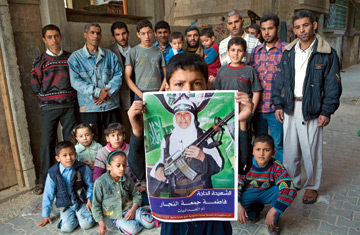
A family member holds up a picture of Fatma Omar An-Anajar, the oldest Palestinian sucide bomber. An-Anajar blew herself up in Gaza on November 23rd, 2006.
(2 of 2)
It is doubtful that all--or even most--of those Palestinian women who sign up to become martyrs do so voluntarily. Some fall prey to male recruiters, who approach them on campus or through Internet chat rooms, making romantic advances that the women fall for. Many other women point to "secret reasons" that have little connection with religion and everything to do with private tragedy or shame. Some see becoming a suicide bomber as preferable to an arranged marriage, common in the Arab world. One teenager volunteered for suicide duty because her father refused to let her marry a boyfriend. As a female student from Birzeit University says, "I'd rather spend my life in an Israeli prison than trapped with a husband that I didn't love."
A disturbing number of women captured and interrogated by Israel recount stories similar to that of Riyashi, of feeling compelled to carry out an attack to restore her family's honor. In one notorious case, Wafa Samir al-Biss, a 22-year-old burn victim from Gaza, went routinely to an Israeli hospital where she received free medical treatment as a humanitarian gesture. Militants convinced her and her family that since she was disfigured she would never get married and that she was better off becoming a martyr. A surveillance camera at Erez checkpoint captured al-Biss's anguish and desperation when her suicide belt failed to go off. Later, crying, she told journalists, "Maybe I have been used" by the recruiters. Al-Biss intended to blow up the very doctors and nurses who had been treating her burns.
Given the apparently abundant supply of women martyrs--willing or not--it is remarkable that suicide attacks against Israelis have been so infrequent in recent years. In March 2002, for instance, militants carried out twice as many suicide bombings as they did all last year. An Israeli law-enforcement officer attributes the drop to "Shin Bet, the fence and God"--but not to any change of heart by the extremists. In fact, renegades from Hamas, by far the largest and most organized Palestinian group, appear intent on restarting suicide missions, motivated partly by the refusal of the international community and Israel to deal with elected Hamas officials. On the eve of the Jewish holiday Passover, April 2, a rebel Hamas cell drove a truck loaded with 220 lbs. of explosives into the center of Tel Aviv. The bomb failed--probably because the driver lost his nerve, according to a military source--but it could have been a mega terrorist attack, killing hundreds of Israelis. Had it succeeded, the attack almost certainly would have induced a massive Israeli retaliation, perhaps triggering a third intifadeh--which Hamas hard-liners openly say is what they intend.
Can it be prevented? Despite the stated goals of the Bush Administration, a peace agreement between Israel and the Palestinians remains at best a distant prospect. The longer the stalemate persists and living conditions for the Palestinians continue to deteriorate, the more likely it is that slaughter will return to Israel's streets. For all the security measures established over the years, defending against suicide attacks relies ultimately on the conscience of the bombers. Israeli intelligence believes women receive far less training and preparation for their suicide missions than do men, ranging from weeks to days; on several occasions, would-be female terrorists refused at the last second to trigger the explosives. Berko says, "One woman prisoner told me how she was supposed to blow herself up in a crowd of Israelis but saw a woman pushing a baby in a carriage. That baby reminded her of her nephew, and she couldn't go through with it." Only by building on such brief moments of humanity can Israel and the Palestinians ever overcome the enmities that haunt them.