

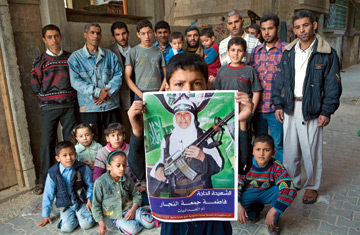
A family member holds up a picture of Fatma Omar An-Anajar, the oldest Palestinian sucide bomber. An-Anajar blew herself up in Gaza on November 23rd, 2006.
In late March, a macabre music video appeared on a television show for Palestinian children. "Duha," 4, as pale as a porcelain doll, is sitting on a bed, watching her mom dress before leaving home. "Mommy, what are you carrying in your arms instead of me?" the girl sings. The next day, Duha gets the answer from the evening news. It turns out her mother was carrying explosives and had blown herself up, killing four Israelis. The final scene shows the girl wistfully rummaging through her dead mother's bedside table. She finds a hidden stick of dynamite and picks it up. The implicit message is that someday Duha will follow her mother into blazing martyrdom.
Abhorrent as such images might seem, the story behind them is even more wrenching. Aired on a TV channel run by the Islamic militants of Hamas, the two-minute re-enactment was based on the life of Reem Riyashi, 22, a Palestinian mother of two who blew herself up in a suicide attack against Israeli soldiers at a Gaza border crossing in January 2004. Riyashi is hailed as a courageous resistance fighter among Palestinians throughout Gaza and the West Bank, but the truth about what drove her to such a terrible act is much more complex. Palestinians in Gaza and Israeli internal-security experts who studied the background of her case say Riyashi's husband had discovered that she was having an affair with a senior Hamas commander. Among conservative Palestinians, as in other parts of the Islamic world, an adulterous woman is often punished with death. Riyashi was given a second option: she could become a martyr. In a video statement released hours before her death, Riyashi, garbed in a militaristic uniform and holding a semiautomatic rifle, sounds tough. "I have always wished to knock at the door of heaven carrying skulls belonging to the sons of Zion," she says. But the pained expression on her chubby, homely face conveys considerably more ambivalence about the idea of annihilating herself to kill Israelis and restore her family's "honor."
For Israeli counterterrorism officials, understanding the mind of a Palestinian woman suicide bomber has become an urgent priority. Since 2002, 88 Palestinian women have attempted suicide bombings, though just eight have been successful. Most were conducted during the height of the second Palestinian intifadeh, before Israelis launched a punishing war against terrorism and erected a security "fence" to separate themselves from the Palestinians. Since November 2006, Hamas, the ruling Palestinian party, has intermittently observed a "truce" with Israel. But on April 25, the militant wing of Hamas announced that it had abandoned the cease-fire. The militants oppose a move by Prime Minister Ismail Haniya, a moderate within Hamas, to form a unity coalition with President Mahmoud Abbas, leader of the Fatah movement, and to take steps toward negotiating with Israel. Now there are signs that armed cells within Hamas are gearing up their assembly line of suicide bombers. As a renegade Hamas military commander says, "We are preparing for the possibility of a third intifadeh."
If so, it's likely that more Palestinian women will end up meeting the same fate as Reem Riyashi. Though there were just six suicide attacks against Israelis in 2006, two were carried out by women. "There's a growing involvement of Palestinian women in terrorism, everything from scouting targets and smuggling guns and explosives to becoming suicide bombers," says Anat Berko, an Israeli counterterrorism expert at the International Policy Institute for Counter-Terrorism in Herzliya, who spent 13 years inside Israeli high-security prisons interviewing convicted terrorists. And yet it remains difficult to pinpoint why certain women turn to martyrdom. Behind the motives of religion and rage at Israeli occupation, Palestinian women, far more than men, tend to choose self-sacrifice as an exit from personal despair, while others are pushed into it for having broken taboos in strict Palestinian society. "These women are both victimizers and victims," Berko says.
Until recently, most female suicide bombers were recruited not by Hamas but by Fatah's armed brigades. The fundamentalist leaders of Hamas, on the other hand, have a more protective view of women and at first were reluctant to sacrifice them. But the Riyashi video, broadcast on Hamas' TV station and produced by Hamas (it can be viewed on YouTube), may signal that the group is using Riyashi's martyrdom to advertise for new female volunteers. In Gaza on April 26, four hooded women in military fatigues announced to the press that they were suicide bombers and vowed, "We will turn Gaza into the Israelis' graveyard if they invade."
After years of study by Berko and other counterinsurgency experts, a profile of Palestinian women suicide bombers is emerging. Male suicide bombers tend to be introverts, the women less so. The women are older and better schooled than their male counterparts. Whereas the men are usually in their late teens and early 20s with scant education, studies carried out by Shin Bet, the Israeli version of the FBI, on 67 women recruited to become suicide bombers from 2002 to 2005 found that 33% were college graduates and an additional 39% had finished high school.
Why do they do it? In October 2003, a glamorous, well-to-do 29-year-old lawyer named Hanadi Jaradat calmly walked into a restaurant in Haifa and blew herself up, killing 21 Israelis and wounding 48 others. In her case, revenge was the motive: Israeli soldiers had raided her home, killing her brother and fiancé, both militants, as she helplessly watched. Several Palestinian intellectuals interviewed for this article declined to publicly challenge the accepted version that women are driven to become suicide bombers out of a desire to avenge Palestinian suffering at the hands of the Israelis. But that's not the whole story. As one professor says, "I accept that Israeli oppression is a factor, but I doubt that every case fits into that category."
At least some of the captured suicide bombers interviewed by Berko say their motivation is the promise of paradise. Terrorist recruiters often tell male martyrs that a bevy of 72 virgins awaits them in heaven. But some women suicide bombers believe that in paradise they will become queens, while others are told by recruiters that no matter how old or grotesque they may be in this life, they will become the fairest of the 72 virgins that await each jihad warrior.