

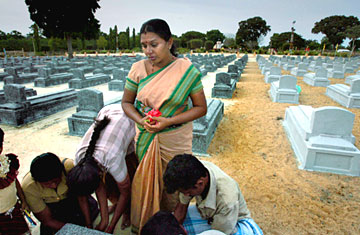
THE DEPARTED: A Tamil woman mourns her dead brother at an L.T.T.E. "martyrs' graveyard" outside Kilinochchi, where the Tamil Tigers have their jungle base
(2 of 2)
The Tigers' bloody insurgency has forced the government to the negotiating table more than once. But there things usually stall, in part because a real settlement would require the Tigers, and in particular longtime leader Prabhakaran, to concede that the group is not the sole representative of the Tamil people. Free elections in Sri Lanka's Tamil region would likely bring moderate Tamil parties to power, threatening the L.T.T.E.'s influence. There is no doubt Prabhakaran is a prophetlike figure for many Tamils, but his power stems as much from his cold-blooded elimination of political rivals and moderate Tamil leaders as from genuine devotion. "Each individual person knows that if his name gets on a list of those who want change [from Tiger domination], they better be very careful," says Father Benjamin Henry "Harry" Miller, 81, a Catholic priest who arrived in Sri Lanka in 1948 and works at a Jesuit school in Batticaloa. Proud and inflexible, Prabhakaran needs the violence—or he risks irrelevancy. "You will not change his mind," says Miller. "You can only stop his mind."
Successive governments have proved just as stubborn. The government's heavy-handed treatment of the Tamil citizens it claims to want to liberate from L.T.T.E. tyranny has merely created more distrust and resentment. Rather than reach out to the Tamil people directly and offer them a degree of autonomy and self-governance that would undercut the Tigers' power, officials have regularly been suckered into more fighting by the rebels. As in Israel, domestic politics plays an important role. The cease-fire in 2002 was signed with a government more open to negotiation. But the election of President Mahinda Rajapakse in late 2005 saw the return of a more hard-line attitude toward the L.T.T.E. Top officials in Colombo oscillate between talking and fighting. "They forget that you can and should deal with the underlying problem with or without the L.T.T.E.," says Dayan Jayatilleka, a senior lecturer in the department of politics at the University of Colombo who was recently named Sri Lanka's ambassador to Switzerland and permanent representative to the U.N. in Geneva. "It's this kind of a trap."
And so the two sides remain locked in a deadly military struggle that diplomats, peace monitors and military analysts say neither can ever win. "They fight each other to the point of exhaustion and stalemate," says the Centre for Policy Alternatives' Saravanamuttu. "Both sides have the ability to take territory but holding it proves difficult." The conflict has now killed more than 65,000, and yet peace seems more distant than ever, especially because the collapse of the cease-fire has destroyed any goodwill that might have existed between the two sides. "We have no way out of this problem other than winning this war," says H.M.G.B. Kotakadeniya, a former deputy inspector-general of Sri Lanka's police and now an adviser to the Minister of Defense. "Otherwise, we will be condemning future generations to endless war."
The violence has infected other parts of Sri Lankan society. The country has high rates of domestic violence and alcoholism. The suicide rate, especially among Sri Lanka's young, is one of the worst in Asia. The fighting and threat of suicide bombings means many children miss long periods of school. Cell phones have turbocharged Sri Lanka's rumor mill and kids are yanked from classes at even the whiff of potential trouble. Many of those who do well in school end up leaving the country for opportunities abroad.
Jayatilleka says the bombings and assassinations have gone on for so long that he now navigates Colombo according to where atrocities occurred. "Every place has a story of violence," he says. "The whole landscape." The brutality colors the way people think about the current fighting. Sri Lankan film star and would-be peacemaker Ranjan Ramanayaka is given to phrases like "the most powerful God is nature," and "the conflict can be ended with the weapon of love, the weapon of having sex, the weapon of making little babies together." But even he recently applied for a gun license after a series of death threats against him because of his antiwar stance. "The élite use war to stay in charge," says Ramanayaka. "The only way to success in Sri Lanka is violence."
Human-rights groups say that disappearances and extrajudicial killings are on the rise again. New York-based Human Rights Watch said in a recent report that followers of Vinayagamoorthi Muralitharan, otherwise known as Colonel Karuna, one of the L.T.T.E.'s most senior military leaders who broke away in 2004 and now fights alongside government troops, have been responsible for hundreds of recent abductions. (Karuna and the military deny committing these acts.) The L.T.T.E., too, continues to kidnap potential young fighters. The violence is not chaotic, as in parts of Africa, but controlled and sadistic. It's as if the entire nation is suffering a slow-burning but destructive psychosis. "There's been a brutalization of society," says Saravanamuttu. "For centuries we have gone through these occasional paroxysms of violence, but over the last three decades we have increasingly relied on violence as the chief form of dispute settlement."
Even the normally peaceful agitate for war. A hard-line Sinhalese nationalist party of Buddhist monks is now part of the ruling coalition. Late last year some of the party's nine M.P.s scuffled with antiwar protesters—mostly Sinhalese but some Tamils—at a rally in Colombo. "Clearly when groups fight, the first attempt should be to solve it through talks," says the Venerable Athuraliye Rathana, who heads the Buddhist group. "But we cannot tolerate [the Tigers'] terrorist activities. We have to destroy [them], and then we can talk." It's the mantra of a nation: kill or be killed. In the camp outside Batticaloa, as Jeevatharsini finishes her schoolwork, her father ponders what he will do next: "Because of the losses I have [suffered], the depression and frustration," says Sinnathambi, "sometimes I get the feeling I should also resort to violence." In Sri Lanka, the reason for war is war.