

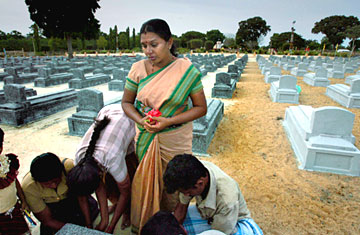
THE DEPARTED: A Tamil woman mourns her dead brother at an L.T.T.E. "martyrs' graveyard" outside Kilinochchi, where the Tamil Tigers have their jungle base
Jeevatharsini lost the arm in artillery shelling five months ago, says her father Loganathan Sinnathambi, who farmed rice until the family was forced to flee fighting between government soldiers and rebel forces in their hometown of Trincomalee last July. They headed south, but each time they found shelter with a relative or in a camp for internally displaced people, as refugees within their own country are known, fighting would erupt again and they would be forced to move on. Last November, the family was cowering inside a tent at a camp in the town of Kathiraveli during a bombardment when a shell landed close by. Shrapnel ripped through the flimsy canvas and into flesh, killing Jeevatharsini's 7-year-old sister, punching a fist-sized hole in her 4-year-old brother's lower back, and slicing into her arm. Sinnathambi has now moved his family further south to the district of Batticaloa, where I found them in a makeshift camp in early March, still in shock at what had happened. "She was full of life before," he says, nodding at Jeevatharsini. "Now she's scared and cries and comes to me all the time. She cries a lot."
Hundreds of thousands of Sri Lankans share Jeevatharsini's scars. In 2002 the Sri Lankan government and the Liberation Tigers of Tamil Eelam (L.T.T.E.), as the rebels call themselves, signed a cease-fire designed to lead to a political agreement. While the rebels want a separate Tamil state in Sri Lanka's north and east, the government wants to keep the island whole. A federation seemed a possible compromise. But peace talks sputtered and then collapsed (both sides accused the other of being insincere), and since December 2005, Sri Lanka has again been at undeclared war with itself. The latest round of bloodletting is much like previous ones—bombings (including a Tuesday blast that killed 15, mostly women and children, in a bus), shellings, suicide attacks against political leaders, government air raids on rebel-held areas, abductions and disappearances of anyone believed to be aiding the other side. In the past 16 months, more than 4,000 people have been killed, and 220,000 people forced from their homes; a total of half a million Sri Lankans are now displaced in their own country. Nordic peacekeepers who are supposed to be monitoring peace have "gone from reporting single shots as [cease-fire] violations to reporting whole battles," according to one international observer who did not want his name used.
Government forces have pushed the Tigers out of much of the east, in part because a breakaway faction of Tamil fighters that fell out with the main rebel group has joined with government troops against their old comrades. The Sri Lankan military is now opening up a new front in the northwest. But there are few signs that the military is on the verge of victory. The L.T.T.E. has used tactical withdrawals to regroup following defeats in the past and is still able to spring surprises. In late February a group of foreign diplomats, including the U.S. and Italian ambassadors, had just helicoptered into Batticaloa, an area the government had assured them was safe, when they came under rebel mortar fire. (Both ambassadors were slightly hurt.) Two weeks ago, in one of its most audacious attacks so far, the Tigers used two small planes (the government says it was just one), which the group had smuggled onto the island piece by piece over the past few years, to bomb an airfield adjacent to the country's international airport outside Colombo. The attack killed three and wounded 16, but officials say government planes weren't damaged. The air attack was so unexpected that the improvised bombers were able to make it back to rebel territory unharmed. The Tigers sent journalists photographs of its new "air wing," including close-ups of an airplane fitted with small bombs and a group shot showing Tiger pilots surrounding a beaming Velupillai Prabhakaran, the group's charismatic but ruthless leader.
Sri Lanka has been in ceaseless turmoil for more than three decades. During the 1970s and '80s, Marxist radicals in the south engaged in a fierce campaign against the government and were just as brutally put down. The conflict with the L.T.T.E. was sparked in 1975 when the Tigers assassinated the mayor of Jaffna, Sri Lanka's northernmost city, and intensified after the killing of 13 soldiers in 1983. Fighting has gone on for so long now that it has brutalized an entire society, creating a culture of violence that haunts the country whether there is fighting or not. In his exquisitely written novel Anil's Ghost, set in an earlier phase of the conflict, Sri Lankan-born Michael Ondaatje describes the unnatural horrors that grip this tropical South Asian island of 21 million people. In Sri Lanka, Ondaatje writes, "the reason for war was war."
As the U.S. grapples with insurgencies in Iraq, and internecine fighting rages on in places like Darfur, the renewal of hostilities in Sri Lanka offers some lessons as to why civil wars are so hard to end. Part of the problem is that fratricidal disputes are often personal and heartfelt. "Both sides see themselves as being locked in a fight against evil," Jehan Perera, executive director of the National Peace Council of Sri Lanka, wrote in a recent appraisal of his country's war. This fight is part ethnic, part religious and wholly vicious. "It is the belief in the unchanging nature of the other that often leads to violence. Both think the other won't change."
In the Middle East, Israelis and Palestinians implicitly understand that a solution to their interminable feud requires a framework in which both sides feel secure, yet they remain deadlocked. Similarly, in Sri Lanka, newspaper polls suggest that Tamils as well as Sinhalese grudgingly accept the need for political compromise. The years of fighting, however, have left people bitter and angry and all too ready to seek revenge in a terrible cycle of violence. "There are those who are very war crazy," says Paikiasothy Saravanamuttu, executive director of the Centre for Policy Alternatives, a think tank. "And the rest often go along."