

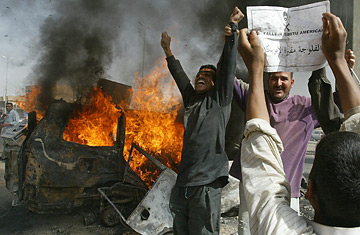
An Iraqi boy holds a leaflet in broken English that reads "Fallujah, the cemetery of the Americans," as people celebrate near a burning car in the flashpoint town of Fallujah, 50 kms west of Baghdad, March 31, 2004. Angry residents armed with shovels mutilated the charred bodies of American contractors after ambushing their convoy.
(3 of 3)
These days Blackwater is pushing ahead, looking for new products it can sell. It is expanding the number and type of aircraft it can provide, including blimps for aerial surveillance. Last year it won the lucrative contract to protect the U.S. embassy in Iraq--the largest American embassy in the world. Blackwater vice chairman Black says he believes the company could also help provide muscle in peacekeeping missions. "Helping people and doing good is a good thing," he told Time. "Blackwater is the premier company in the training area and security solutions area. If my mother needed protection, if you're going to Iraq, you'd be nuts not to hire someone like Blackwater."
The Pentagon seems likely to keep creating opportunities for private contractors. The agency's 2006 Quadrennial Defense Review, a strategic assessment of the future for the U.S. war machine, envisions their expanded use. The report describes contractors as an integral part of the "total force" and describes ways to further integrate contractors into war-fighting capability. The previous strategic report, published before 9/11, doesn't even contain the word contractors.
Despite the Pentagon's support, U.S. lawmakers are calling for a dramatic reappraisal of how the military uses these men. There is certain to be greater demands for transparency. Since private contractors now are not required to open their books, no one can be certain how many are in Iraq; even the Pentagon doesn't keep track. Democratic Representative Jan Schakowsky of Illinois, who has taken a personal interest in Katy Helvenston's story, introduced a bill in the House that would, for the first time, require the creation of databases to monitor the deployment and cost of contractors. Only last fall did the Department of Defense conduct a poll of some contracting companies, which came back with the suspiciously round number of 100,000 contractors operating in Iraq. "An owner of a circus," says Peter Singer, author of Corporate Warriors, "faces more regulation and inspection than a private military company."
The night before Scott died, Katy Helvenston had turned her phone's ringer off while she slept. When she woke up, there was a message from him.
"Hi, Mom. It's your son. It's 2 o'clock in the afternoon here," he said. "We're all safe with our body armor. It's all good, Mom. Just wanted to say I'm safe and that I love you and, ah, I love you, and have a great day."
For almost three years, Katy has kicked herself for missing his call. She wonders what Scott would have told her about some of the things that were going wrong with his mission that day. Maybe she could have persuaded him not to go. She knows that's unlikely--the same kind of willful wishing that any mother whose child was killed in action might have. It's too late to keep him safe, but she still wants to know what happened after he hung up the phone. And because her son died for his company, not his country, she's in for a fight.