

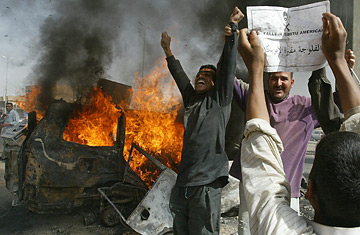
An Iraqi boy holds a leaflet in broken English that reads "Fallujah, the cemetery of the Americans," as people celebrate near a burning car in the flashpoint town of Fallujah, 50 kms west of Baghdad, March 31, 2004. Angry residents armed with shovels mutilated the charred bodies of American contractors after ambushing their convoy.
(2 of 3)
Now Blackwater and other security contractors are a ubiquitous presence in Iraq. The skies buzz with their single-striped Little Bird helicopters. When I was a correspondent in Baghdad in 2004, Blackwater convoys were notorious for bringing a Wild West mentality to the streets of Baghdad. They were easily identifiable--speeding white suvs with black-tinted windows and automatic weapons pointed at you. Hired guns are even more in evidence at the checkpoints in Baghdad's Green Zone, although there is a hierarchy as to who guards what. The outer gates of compounds are typically guarded by third-country nationals, experienced soldiers of fortune from such countries as Nepal, Chile and Fiji who are paid a fraction of what a British or American former soldier or policeman would get. The highest-paid independent contractors are known as tier-1 personnel. These are the former U.S. special-forces soldiers. On Helvenston's tour in Iraq, he was making about $600 a day. He was on a 60-day rotation and stood to make some $36,000 in two months.
What Went Wrong in Fallujah
When Helvenston was killed, Blackwater was expanding its business in Iraq from being just bodyguards. The company wanted to make a bid to take over security for convoys delivering kitchen supplies to U.S. military bases in Iraq. The families claim that Helvenston and the others were on one of the first such missions, put together hastily and on the cheap to impress their prospective client--a few contractors up the chain--the U.S. Army. Time has obtained the first eyewitness testimony given under oath that describes the events leading up to that convoy. In a 194-page sworn deposition filed with the Department of Labor in a separate legal proceeding, Christopher Berman, who worked and roomed with Helvenston in weeks leading up to his death, describes a company's managers overwhelmed by logistics and plagued by volatile tempers as they rushed to take over the new contract.
Like Helvenston, Berman had been a Navy seal. The two had never served together but knew each other. Helvenston had modeled in a Navy seals calendar Berman had produced, and Berman had helped sell fitness videos that Helvenston had made. Before Helvenston died, said Berman, the two had been thinking of starting a rock-climbing business together. Neither man had discussed going to work for Blackwater before they literally ran into each other boarding the same plane at John Wayne Airport in Santa Ana, Calif. By coincidence, they were both heading to Moyock, N.C., for a 10-day Blackwater training course. They spent the training together as roommates.
Berman says there was a disjuncture between what they were told in training and the realities they found on the ground. Most of the training they did at Moyock "revolved around armored vehicles and operating armored vehicles," he testified. The vehicles that the Blackwater team was driving on March 31 were not armored; they had only a piece of metal behind the backseat. During training, team members were told that they would be sent to Iraq with semiautomatic M4 machine guns and Glock handguns and that larger weapons, like a belt-fed 5.56 machine gun squad automatic weapon, would be issued upon arrival. They were also told they would be doing advance work in Iraq, gathering intelligence, inspecting routes and doing prep work before starting a new contract.
But when they arrived in Iraq, there were no heavy weapons or hard cars. Just as important, their project manager, a heavyset American they called Shrek, prevented them from doing the promised preparations, Berman says. Blackwater's team was in a hurry to take over the contract to escort kitchen supplies to a U.S. military base near Fallujah from a British security company. The British company offered to have the Blackwater guys ride along with them to get to know the general routes and threats, but Shrek said his team was "way too busy," according to Berman. Blackwater also didn't provide the men with any maps, Berman said, and the few they did obtain came after "begging around" on nearby U.S. military bases. They did have global-positioning systems, said Berman, but lacked the coordinates of their destinations.
The day Helvenston died, there were only four men on his team, two per vehicle, instead of Blackwater's standard three per vehicle for security convoys. Berman testified that the presence of only two operators in Helvenston's vehicle contributed to his death because it "took away the entire back field of operation"--no third person in the rear vehicle who could be assigned to watch for an attack from behind.
Blackwater's defense revolves around the issue of who has legal responsibility when something goes wrong. Blackwater's lawyers say the four men were operating as part of the U.S. "total force" in Iraq. As such, they claim, the company could no more be sued than the U.S. Army could for something that happened in a war zone. And they argue that any compensation for the families (28 Blackwater men have died in Iraq) would have to come from the U.S. government, not from Blackwater.
That legal strategy could prevail. Congress passed the Defense Base Act in World War II to give construction workers who were building bases in Europe coverage in case of injury or death. And the law was expanded in 1958 to include contractors operating off bases in war zones. But there are also early signs that Blackwater's argument may not win the day. In a pretrial hearing, the North Carolina judge scolded Blackwater for saying that it speaks as part of the total military force. "Blackwater has wrapped itself in the American flag," Judge Donald Stephens told the firm's lawyers. "Blackwater Security Consulting LLC is not the United States government."
Meanwhile, the U.S. is starting to investigate the company. The House Committee on Oversight and Government Reform invited Helvenston, Batalona's daughter Crystal, Teague's widow Rhonda and Zovko's mother Donna to testify in February. The issues of negligence were raised at the emotional hearing, but so were more technical violations. There is, for example, the question of whether the chain of subcontractors that led to Blackwater on that day was even authorized to hire private security. Under logcap, the contracting program that provides private logistical support to the U.S. military in Kuwait and Iraq, all security was supposed to be provided by the military.
A Push to Scrutinize the Gunslingers