

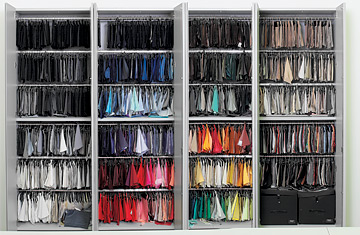
A fabric archive Miuccia Prada uses to develop her collections.
(2 of 2)
Every season, her collection starts once Prada has chosen a concept. Then she will turn to different fabric mills and ask for special treatments of fabrics that interest her (90% of the fabrics are created exclusively for Prada). The mills will come back with 25 or more variations on her request. "That is the real luxury of being a big fashion company. When you are big, the quality is better," she explains. For the average women's fall-winter collection, she will focus on as many as 50 different fabrics, eventually narrowing the final selection down to 20.
But sometimes the process is not as smooth as she envisions, and last-minute mishaps can cause snags in the creative process. For the spring 2007 Miu Miu show, for example, Prada had the idea—researched in her historical archives—of using a heavy, old-fashioned, expensive silk satin. "We printed so much, and afterward we realized that only one worked," she says. In the end she created an entire collection out of two fabrics: printed satin and plain satin. "We reprinted them three days before the show! It was a big drama."
Prints and historical references to prints are a large part of Prada's fabric research, and she draws on her archives, which include endless shelves of swatch books dating back to the 1800s and early 1900s as well as old fabric stocks that she has bought out and stored in warehouses in Tuscany. For fall 2003, Prada snapped up a huge lot of Art Nouveau and 1960s psychedelic prints from the Savile Row tie company Holliday and Brown, which she incorporated into men's and women's collections and then used for further inspiration, taking later copies of the prints and playing around with them. "What I like to do sometimes is use the computer-graphic representation of old fabrics," she says.
For the fall 2004-05 collection, Prada spent three months working with textile mills developing first a very fine thread and then a computer-graphic print that was inspired by images of 18th century ruins. Using pixelated computer screen grabs, she reprinted copies of the original images onto faille and brocade, giving them a moiré effect. The final print had a high-tech feeling, but the fabric was traditional.
In other seasons, Prada will return to the authentic way of making a very pure fabric. For years she wanted to develop a traditional gold cloque and lamé of the quality that came out of the French mills in the 1960s, but the reproductions didn't have the weight and quality of the vintage fabrics. So Prada dispatched a team of researchers to one of the original mills in France, and 10 days later, using old machines that had been out of service since the 1960s, they reproduced exactly the same fabric with the kind of quality she was looking for from the earlier era.
What's next? "I'm completely into innovation," she says. "I don't even want to see anything unless it looks completely new."