

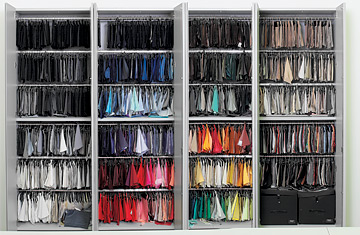
A fabric archive Miuccia Prada uses to develop her collections.
Not so long ago, the spectacle of fashion was in the fabric, not the celebrity-filled front row. The material mattered more than the scene—more than the next It handbag. I remember visiting Yves Saint Laurent's studio for an haute couture preview when the designer himself was still working, fitting dresses on models. Saint Laurent and his aide-de-camp Loulou de La Falaise were yanking huge bolts of color-saturated Abraham silk down from the shelves and spinning out a fantasy scene of a hot summer day in New Orleans circa 1860, complete with big taffeta skirts and wide-brimmed hats. It was as if the fabric were speaking to him—and so vividly that even the model looked as if she might start to melt under the hot Southern sun.
Back then even the fashion press—which now seems more interested in celebrity mating habits than in the art of making beautiful clothes—used to list the textile mills where these raw materials of fashion dreams were woven. A journalist on deadline who now might be more familiar with the spelling of Lindsay Lohan's name once had to know how to spell the names of the famous fabric houses: Ratti, Bucol, Gandini, Clerici, Guigou, Mantero and, of course, Abraham, the Swiss fabric house owned by Gustav Zumsteg, the late, great textile designer who invented the stiffly finished silk gazar that gave shape to Balenciaga's gowns and who also collaborated with Saint Laurent, Coco Chanel and Hubert de Givenchy.
To be sure, fabric can't talk or cause a scandal or convulse the blogosphere. And maybe there is something fusty and old hat in caring too much about the provenance of a silk shantung or getting all weak-kneed about a suit made of cellophane-backed wool. But the art of couture glamour is ultimately about the connoisseurship of material, and there have always been designers who knew this and obsessively attended to the fabric of fashion.
"For me fabric is 90% of the mental work in design," says Miuccia Prada, who most recently made a bold statement on the runway with duchess satin, a fabric most commonly used today in bridal dresses. "It's where I spend most of my time because the quality of the fabric is fundamental. When I get the fabric done, the show is done. I am at ease."
Like Prada, there are a handful of designers over the past decade who have made headlines with fabric. In the mid-1990s, Helmut Lang and Jil Sander started incorporating techno-fabrics like nylon and carbon into more traditional weaves, giving them a lighter hand or a three-dimensional quality. They pushed the boundaries, often employing far-out materials like rubber and plastic. More recently, Alexander McQueen has expressed a ghostly romantic vibe with fine spiderweb netting. Francisco Costa has been playing with perforated latex and stretch scuba at Calvin Klein. And at Fendi, Karl Lagerfeld reintroduced the idea of rubber, pleating it around evening columns like a sci-fi mummy.
Any fashion insider knows it's through fabric development that you can divine what's next in fashion and what will come down the runway, say, for spring 2008. Even while designers were putting the final touches on their fall 2007 collections last month, they were dispatching fabric teams to the big trade fairs—Premiere Vision in Paris, Moda In in Milan—to scour the market for spring 2008. And looking at those fabrics is like looking into fashion's crystal ball, especially if you are a designer like Prada, who is widely considered one of the most adventurous when it comes to how far she will push the textile mills in new directions. She loves to tell the story of kid mohair, a kind of plush, teddy-bear-like pile fabric that was considered completely uncommercial before she used it in a menswear collection for spring 2002. "I was forbidden to use it," she says with a laugh, "and of course, it became a best seller for us."
This is Prada's hallmark: irreverence mixed with industry. Her love of fabric dates back to her childhood and her family history: her mother was originally from the Como region of northern Italy where the silk textile factories are located. "I had silk in my hands all the time," Prada says, "the finest silk made with the thin threads of silk—a quality no longer available."
Indeed, Italy's mills—from the silk manufacturers of Como to the wool and sportswear producers of Tuscany and the cashmere and menswear fabric mills of Biella—are Europe's largest producers of luxury textiles. And, along with the Japanese, Italians are considered among the greatest fabric innovators. "They innovate by constantly looking outside their industry for ideas," says Angelo Uslenghi, a Milan-based textile cool hunter. "There is not much new you can do to yarns and weaves, but you can look outside the textile industry at other industries such as fine jewelry where they use techniques like filigree, chiseling and engraving. The innovators in textiles are now doing this—they're applying these kinds of techniques and effects to fabrics."
Another source of inspiration is embellishment—something that Prada has been refining for years. "To do something new, you have to combine fabrics," Uslenghi explains. "You bond different fabrics, fuse them together." Looking even further ahead, to spring 2008, he says textile mills are using lots of sculpting and etching techniques that create a kind of bas-relief effect on fabric. A traditional, rich fabric like silk shantung, for example, will be woven with very coarse yarn and linen hemp so that the surface looks embroidered, "almost in an arte povera way," Uslenghi says.
Prada's penchant for mixing luxurious traditional fabrics with new high-tech fibers has been consistent over the past decade, but from season to season, her eye will veer from very traditional fabrics like duchess satin to something unconventional like the novelty fabrics she used in the early 1990s when mills were introducing technology from the athletic-wear industry. But in Prada's hands even those fabrics were not used in a traditional way: nylon replaced leather for bags; it became shiny, luxurious and embroidered for evening coats; or it was woven with purer yarns like cashmere to give it a stiffer hand. "I like to mix it up and make things in the opposite way than they were meant for," she explains. "Sometimes I ask [fabric mills] to mix up new combinations for the most normal fabrics—like something more stiff or more fluid or more opaque. I hate generically appealing fabrics."