

(4 of 4)
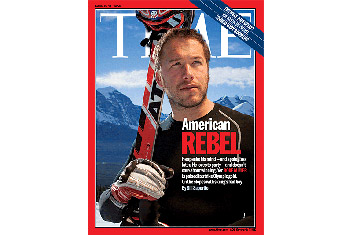
Similarly, Miller has his own ideas about training that have clashed with his coaches'. The USSA, like most sports federations, uses standard testing to evaluate athletes. That, says Miller, causes athletes to train for the test, not the sport. He believes that ski racing requires a different approach to fitness. "My team has been very unreceptive about the fact that I consistently show them that I train slightly differently than they do, that I consistently show them that I am in better shape for ski racing than anyone else on the team," he points out. And why wouldn't he know better than they what will work for him? "I didn't feel anyone is more equipped to analyze that than I was," he says. "I've been myself my whole life."
Last year, after tinkering with his boots, he discovered that inserting a composite — as opposed to aluminum or plastic — lift under the sole gave him a better feel on the snow and better performance. Then he did something really crazy: he shared the information with everyone, including competitors. His equipment team flipped, but in the Miller school of philosophy this makes complete sense. Otherwise, he says, "I'm maintaining an unfair advantage over my competitors knowingly, for the purpose of beating them alone. Not for the purpose of enjoying it more or skiing better. To me that's ethically unsound."
His approach clearly works. He has won two Olympic medals, four world championship golds and 19 World Cup events. In a sport in which athletes tend to specialize in either the speed events (downhill, super-G) or technical events (slalom, giant slalom), Miller does it all. In the first race after his apology, Miller smoked the slalom part of the day's super combined event (downhill and slalom), putting him more than a second ahead of the field. It's an astonishing feat, given that most racers are separated by hundredths of seconds. He was, however, disqualified on a technicality, despite a U.S. protest.
Another losing day? Not necessarily. He had accomplished something, proving again that his willpower, his think-first, ski-better approach, had prevailed. That must have made him happy. And he probably had a beer afterward. That probably made him happy too. [This article consists of a complex diagram. Please see hardcopy of magazine or PDF.]
Big Man on the Ski Slopes
Bode Miller, the skier with the unorthodox style, is one of the few racers with the stamina and versatility to compete in all five Alpine events in Torino. In addition to the four shown here, Miller will ski the combined event, which is a shorter downhill run followed by two slalom runs DOWNHILL Vertical drop: 2,625 ft. (800 m) It’s the longest course of the Alpine events and one of the most dangerous competitions at the Winter Games, with speeds of more than 80 m.p.h. (130 km/h). Skiers take one run down a single course marked by a few control gates, and the fastest time wins. Racers may take practice runs • All control gates are open (perpendicular to the run) to mark the course SUPER-G 2,130 ft. (650 m) Shorter than the downhill but longer than the giant slalom, the super giant slalom combines speed with technical turns. Racers carve fast turns over a single course with at least 35 directional changes, at speeds of more than 60 m.p.h. (100 km/h). A morning inspection is allowed, but no practice run • Some gates are closed (parallel to run) to force turns that control speed GIANT SLALOM 1,475 ft. (450 m) It’s a looser, faster version of the slalom, with wider turns. The fastest total time from two runs on different courses wins. Parabolic (hourglass-shaped) skis used for the past 15 years have allowed better control, so more traditional speed racers are entering this event. Only an inspection is permitted • About 50 sets of open and closed gates SLALOM 720 ft. (220 m) It's the shortest course, with the quickest turns. Racers use short skis and body armor to protect against the impact of gates. Each skier makes two consecutive runs down the same slope on different courses. The lowest combined score wins. Only an inspection is permitted • 55 to 75 gates, including flushes (three or four closed gates in a row) and hairpins (two closed gates)