

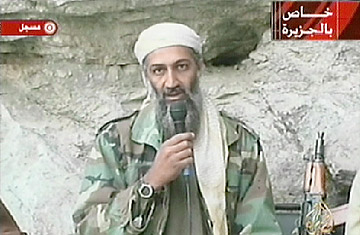
Osama bin Laden is seen in this video footage recorded "very recently" at an undisclosed location in Afghanistan aired by the Qatar-based satelite TV station al-Jazeera October 7, 2001.
(4 of 9)
They seemed to be in a rush to fly the big planes. Long before they were really ready, before they had the 1,000 or so hours any airline would demand of a future jet pilot, they invested in expensive time in a training device. The 727 full-motion simulator is a multimillion-dollar contraption that twists and bucks and turns on hydraulic pistons like a Disney ride. But the technology is good enough that airline pilots use simulators regularly to train for emergencies that are too dangerous to practice in a real plane: a double-engine failure or a fire on takeoff. For $1,500, Atta and Al-Shehhi bought six hours of simulator time from Henry George, who owns the SimCenter School in Opa-Locka. He led them through a few basic maneuvers: climbs, descents, turns. It wasn't much, but it was enough to give a beginner pilot a realistic sensation of how to handle a three-engine jet airliner. And enough, later, to break George's heart. "To think that I helped in any way their terrible cause, that my skills were used for such a terrible deed," he says. Al-Shehhi was on board United Flight 175 and was probably the pilot of the airliner as it smashed into the side of the World Trade Center's south tower. Atta was on American Flight 11, which had hit the north tower 21 minutes earlier.
They were not, it seems, alone in their training. Waleed Alshehri, in his mid-20s, had graduated in 1997 with a degree in aeronautical science and a commercial pilot's license from the prestigious Embry-Riddle Aeronautical University in Daytona Beach, Fla., where nearly a quarter of all commercial pilots train. He surely knew how to fly the large aircraft the terrorists planned to ram into their targets. He was on American Flight 11 with Atta. Abdulaziz Alomari told his Vero Beach landlord in July 2000 that he was a Saudi commercial pilot when he moved in with a wife and three kids. He was then taking classes at FlightSafety Academy, often patronized by employees from Saudi Arabian Airlines. He too would have had the rudimentary skills needed to steer an airliner. Says a neighbor: "My kids played with his kids. I'm stunned." He was aboard Flight 11 as well. Of the five hijackers on board, four were U.S.-trained pilots.
As far back as 1996, at least two other men were following a similar course. Hani Hanjour, another of the eventual hijackers, was working with a CRM Airline Training Center in Scottsdale, Ariz. By 1999 Hanjour had accumulated enough hours--250--to fly with an FAA examiner for his commercial pilot's license. It was awarded and issued that same year. His address: a post-office box in Saudi Arabia, though for much of the past year he had lived with two other men, Nawaq Alhamzi and Khalid Al-Midhar in a San Diego apartment complex.