

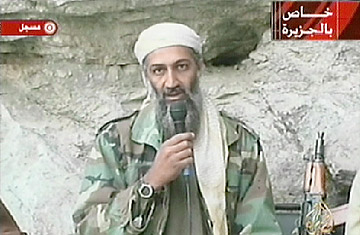
Osama bin Laden is seen in this video footage recorded "very recently" at an undisclosed location in Afghanistan aired by the Qatar-based satelite TV station al-Jazeera October 7, 2001.
(3 of 9)
But the 19 men who carried out last Tuesday's attacks were different. They did their most important training right here, among us. They were "sleepers," unusually purposeful men, living ordinary lives as they prepared for extraordinary deeds; they had plenty of time to change their minds if they had wanted to. They lived by the terrorist handbook cited in the East Africa embassy-bombings trial: "When you're in the outer world, you have to act like them, dress like them, behave like them." They were older--one age 33, several in their late 20s--educated, technically skilled people who could have enjoyed solid middle-class lives. Some left wives and children behind. Yet even more ardently than their young predecessors, these men made common cause with each other out of some profound hatred for America. Investigators don't know yet if they were recruited or they volunteered, but their need to do violence to the enemy and their unflinching will to carry the plan through over months, even years, brings a terrible new dimension to the dynamics of terrorism.
It is one of the truisims of the modern airline industry that the U.S. trains many of the world's pilots. The backs of international pilot magazines are crammed with ads for flight schools in Florida, California and Arizona. "Three hundred sunny days a year," some of them proclaim, an enticement to students in a hurry to build up the hundreds of hours of basic prop-plane time needed before moving on to jet training and potentially lucrative careers. If Harvard, Yale and M.I.T. draw the world's future biochemists, these small four- and five-plane aviation schools attract the globe's future pilots.
Huffman Aviation, tucked on Florida's Gulf Coast between Tampa and Fort Myers, is just such a place. The weather is good. Gas and airplane rentals are cheap--you can fly a Cessna 150 single-engine plane for $55 an hour, 40% less than what you might pay in a big city. The airport cafe is open, serving hot, cheap food with aviation nicknames like "Emergency Descent," a bacon cheeseburger.
For the better part of the past year, as the U.S. elected a new President and pondered the Internet bust, Mohamed Atta and Marwan Al-Shehhi spent their days buzzing up and down the Florida coast in small Cessnas, building time. Their training began in earnest in July. They were quiet and private. For a week or two they leased a room--$17 a night--from Charlie Voss, a bookkeeper at Huffman. But Voss's wife did not like their slovenly habits. In the morning they would pad from the shower with wet hair and snap their heads around. "You've been here long enough, and you need to find a place," Charlie told the two. "Go to it."