

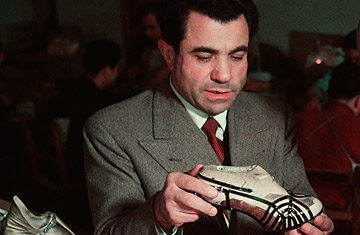
Italian shoe designer Salvatore Ferragamo with a selection of his shoes, Florence, 1953.
MAGICAL THINGS, SHOES. Myths and fairy tales are cluttered with them. There is the old woman who lived in a shoe and the young woman, in Hans Christian Andersen's The Red Shoes, who died for one. Cinderella's glass slippers and Dorothy's ruby pumps still tiptoe around the imagination. In the ancient Indian epic the Ramayana, the exiled king leaves behind a single memorable token: a pair of gold-encrusted shoes. Newlyweds once routinely tied a pair of old brogues behind their coach or car for good luck. In the Middle Ages the well-to-do wore poulaines, shoes with pointy, turned-up toes that were thought to ward off witches.
Salvatore Ferragamo, a stocky, wavy-haired Italian shoemaker who first apprenticed himself to a cobbler when he was nine years old, was a magician who worked with feet. He well understood the talismanic power of shoes, their ability to enchant and arouse, to dazzle and intrigue. He created shoes that were walking fantasies. But at the same time he was a craftsman who understood how a pair of ill-fitting shoes can ruin a day and how a pair of clunky shoes can make a duchess feel dowdy.
Shoes cannot simply adorn; they must protect and support. As a design object, they unite form and function, utility and style. Ferragamo's shoes were as engineered as a suspension bridge and as theatrical as a butterfly. "Elegance and comfort," he once wrote, "are not incompatible." From the moment he began making shoes in 1907 until his death in 1960, his motto was that women did not have to suffer to be beautiful; shoes did not have to pinch to be chic.
Ferragamo's mixture of prettiness and practicality is sumptuously on view in "The Art of the Shoe," a 30-year retrospective at the Los Angeles County Museum of Art. The exhibition, which will run through June 7, is a shrine to Ferragamo's shoes, with dramatic spotlights illuminating the glass cases containing his handiwork. The 199 shoes in those cases were chosen from among 10,000 in storage at Ferragamo headquarters in Florence. The Los Angeles setting is appropriate: Ferragamo got his start as a custom shoemaker while living in California between 1914 and 1927. It was Hollywood that first encouraged him to create shoes that were extravagant and unique; and it was Hollywood that encouraged women around the world to wear them.
Ferragamo's life story too has a once-upon-a-time quality. He was born in a remote hill town outside Naples, the son of an impoverished farmer. In his autobiography he recounts that when he was nine, his parents were distraught because they could not afford a pair of traditional white Communion slippers for his six-year-old sister. The afternoon before the event, Ferragamo borrowed tools from a friendly local cobbler and stayed up all night making a pair of perfect white canvas shoes for his sister.