

(6 of 8)
Then Lin and Mao created the Red Guards by the simple if shudder-making device of closing the high schools and universities of China indefinitely and turning the nation's youth loose on one long, glorious holiday of travel and excitement in the service of Mao. Lin's army helped organize the youth into coherent bands, equipped them with uniforms and badges, and sent them out to give their elders what-for in a lark whose attractiveness any teeny-bopper or Berkeley rebel would instantly recognize. Mao thus hoped to fire with revolutionary fervor the very generation that he felt Russia had lost to "revisionism," the generation of Red Chinese that Dean Rusk once expressed the hope might be "recuperated." The Red Guards were not, after all, a new idea in history; Germany had its Hitler Jugend. Millions of Red Guards poured into Peking and other big Chinese cities. How well Mao's notion has worked could be seen last week in a wall poster signed by Liu Shao-chi's own daughter, in which she denounced her father and mother, accusing them, among other things, of not allowing her to tape record their conversations at home.
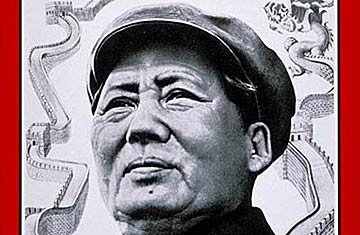
Mao-Think. Legions at the ready, Mao set out last June to throw China back into an age of simplicity and Spartan evangelical purity that it had never really known. If China's young no longer needed education, neither did any working adult need expertise: for both, the contemplation of Mao's teachings was enough. Explorers lost in the Gobi Desert threw away their compasses and were led out by Mao-think. A North China girl spinner started out tending 100 spindles at a time but, after studying Mao's works, was soon handling 1,600 with ease. Top-quality steel was forthcoming from an out-of-date converter once the operator began "applying the philosophical concepts expounded in Mao Tse-tung's writings." The Peking Review carried an article entitled: "How We Invented a Handy, Light, Well-Finished and Inexpensive Electric Wall-Ramming Machine by Grasping the Principle of Contradiction."
Inspiring as such examples seemed in print, to the level-headed men charged with running China on a day-to-day basis—from factory managers to government bureaucrats to party officials like Liu and Teng—it looked like the Great Leap Forward of 1958 writ large in madness. By its do-it-yourself backyard-foundry mania, Mao's Great Leap had cost China several years of economic growth. The new revolution was to be far more encompassing, and it also threatened the technocrats' jobs. In a factory run by Mao-think, who needs a manager or even an engineer?
Not surprisingly, when the first bands of Red Guards approached the assembly lines last fall, with their little, red pocket versions of Mao's works, some ugly clashes took place. Chou Enlai, always the mediator, stepped in and decreed that Red Guards were henceforth to refrain from interfering in industrial production or farming methods. But at the same time, Lin made plain to the Red Guards that the retreat was only temporary so far as Mao's grand scheme was concerned.