

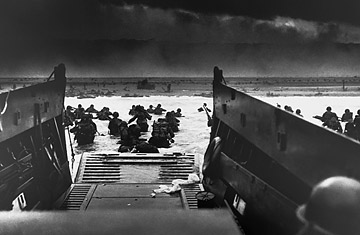
BATTLE OF FRANCE
The Allied Expeditionary Force battled two stubborn foes. One of them, the Germans, was reasonably predictable. The other, the weather, defied close analysis and for that reason gave the Allied high command the kind of trouble it had hoped to avoid.
Supplies and reinforcements were moving across the Channel and up the beaches in great volume. Even the Germans admitted that. But the Allied high command made no bones of a sobering fact: unloading had been thrown behind schedule.
So had the work of supporting air power, the one decisive advantage the Allies hold over the Germans. Up to the end of the first week, the invasion of Western Europe had not had the smile of a single clear day comparable with those which beamed on Hitler's legions in the Battle of France in 1940.
The difficulties of landing food, fuel and equipment from ships lying in the rough-water anchorages of the Bay of the Seine gave the first clue that the invasion was running behind schedule. The second was in the slow deepening of the bridgehead: an average of barely three miles a day. So it was that soldiers, who had ap proved General Eisenhower's gamble on the weather, retreated from their first optimistic judgments of the invasion,, which were based on the relative ease with which all but one of the scheduled landings were accomplished, the low casualties, the slow ness of German reaction, the virtual absence of the Luftwaffe. Now, as the fight ing progressed, there was still no indica tion that casualties were becoming prohibitive. But there was every indication that the rate must be increasing.
The Simple Plan. The immediate strategy of the invasion was clear, simple, masterly: 1) to seize beachheads on a sector of coast well within efficient fighter- plane range and economical shipping range of southern England; 2) to join and deep en them, thereby making a solid bridge head; 3) to drive southwest across the base of the Cotentin Peninsula, severing it from the rest of Nazi-held France; 4) to swing north and take (from the rear) the great port of Cherbourg. In the first week, everything depended on the Allies' ability to land enough sup plies on the obstacle-strewn beaches to sustain their forces until Cherbourg could be taken. Thereafter, Cherbourg would be the port of entry. It was a foregone conclusion that the Nazis' demolitions would wreck the tide gates of Cherbourg's commercial basin; they might have some temporary success in blocking the entrances to the harbor by sinking ships. But there was little they could do to lessen the usefulness of the magnificent roadstead.
Port of Necessity. There was no doubt that, once Cherbourg was taken, U.S. and British engineers could have the port usable again in a few days. Within the shelter of the five-mile-long roadstead, even lightering in supplies would be far easier and faster than in the wide-open Bay of the Seine, or in the tiny fishing-village ports opened by Royal Marines.