

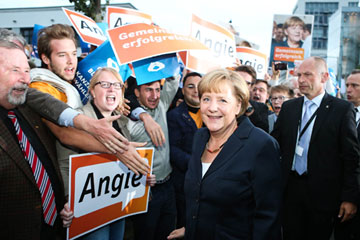
German Chancellor Angela Merkel greets her supporters outside a studio ahead of the TV debate in Berlin, Germany, Sept. 1, 2013.
(4 of 4)
That's because the German political system already spreads those powers thinly between state and national government and parties. The SPD is campaigning for a coalition with the Greens; Merkel aims to continue her cúrrent liaison with the Free Democrats. Polls point to a grand coalition of Merkel's CDU/CSU with the SPD, the same constellation she led successfully during her first term as Chancellor, but any final constellation will almost certainly be decided not just by voters but also in detailed coalition negotiations after the elections.
Putting Trust in Mutti
In the final months of East Germany, Lothar de Maizière, who served as the only elected leader of the GDR before its absorption into reunited Germany, appointed Merkel his deputy spokeswoman. She shone. "Her briefings were half as long [as her colleagues'] but twice as information-rich," says her former boss. He did ask his office manager to have a quiet word with Merkel on the eve of a diplomatic trip to Russia. "Please tell her to lose the Jesus sandals and buy some clothes better suited to public office," he begged. Merkel turned up to work the next day in a new outfit but blushed when de Maizière complimented her on it.
Merkel's stolidity is now being showcased as an asset in a campaign devised by the Berlin-based agency Blumberry. The campaign's must-have collectible is a booklet of photos of the Chancellor, including a few private shots from family albums, garnished with modest biographical details. Here is Merkel with her husband, distinguished scientist Joachim Sauer, who is even more publicity-averse than his wife. And here's a much younger Angela pushing a doll in a buggy, playing mother, as the childless politician now plays mother to her entire country.
Ordinary citizens feel safer in Mutti's care. The election could be seen as a rite of passage, giving voters a choice between the comforts of the government they know or striking out into the unknown. The SPD's Nahles hopes to convince them that they need to cut loose from the apron strings in order to preserve their comforts. "This government will go into the German history books as the one that has made the fewest laws," she says. "Staying still for a country means, in the end, going backward."
Merkel agrees. In Recklinghausen, she speaks of the need to modernize Germany's economy to meet the trials of globalization. But she also repeats her campaign slogan "erfolgreich zusammen"--successful together. Her message is that Germany is already on the right path. Small steps, not big ideas, are the way forward. "She's so admired because the way she does things is close to the German soul," says a campaign insider. Win or lose, Merkel represents contemporary Germany in all its complexity, a huge country that prefers to behave like a small one.