

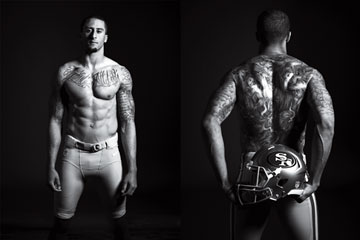
(2 of 4)
Kaepernick's tats--he started inking his arms in college--have fed the stereotypes. In November, a Sporting News columnist wrote that "NFL quarterback is the ultimate position of influence and responsibility. He is the CEO of a high-profile organization, and you don't want your CEO to look like he just got paroled." The column was properly derided. "I almost want to say that's very old school," Kaepernick says now. "To me, tattoos are a way of people being able to express themselves and have other people look at them and get a little insight into who they are, without ever even saying a word to them." Faith is inscribed on his right bicep, respect on the tricep. He also tattooed Psalms 18:39--"You armed me with strength for battle; you made my adversaries bow at my feet"--on his right arm. "All my tattoos, they've been thought out, thought over, been a work in progress for at least a year before I've got them," says Kaepernick. "So I'm not walking into a tattoo shop, picking tattoos off a wall. It's something that means something to me. It's something that I believe in."
That Sporting News column, though poorly executed, did raise a legit question: Are fans--particularly white fans--conditioned to expect a clean-cut quarterback? "I think it's a perception that's been around for a very long time," says Kaepernick. "It's a perception that I want to break. I don't want people to think you have to look a certain way or be a certain mold to be able to be a quarterback."
Just nine months ago, no one thought Kaepernick would change the face of football. In the 2011 season, San Francisco starter Alex Smith led the Niners to the NFC championship game; rookie Kaepernick carried the clipboard. But Smith suffered a concussion in Week 10 last year. Kaepernick took over. When Smith was ready to return, coach Jim Harbaugh stuck with Kaepernick, igniting a debate about whether a starter should lose his job because of injury. But Harbaugh, a former starting QB himself, was witnessing the birth of a star. (Smith now plays for the Kansas City Chiefs.)
Kaepernick was barely recruited by big-time Division 1 colleges. He took a last-minute scholarship offer from the University of Nevada; otherwise Kaepernick, who could throw over 90 m.p.h. in high school, would have pursued baseball. And if a kindhearted family from Wisconsin hadn't suffered two gut-wrenching tragedies, it's unlikely there would be a Colin Kaepernick shaking up the sport.
Tragic Blessing
In 1977 Rick Kaepernick, now senior Vice President of growth and development at Hilmar Cheese Co., near Modesto, and his wife Teresa, a retired nurse, were living in their native New London, Wis., when Teresa gave birth to Kyle, now 35. A second son, Lance, was born nearly two years later, but he died of congenital heart failure just 23 days after birth. The following year a third son, Kent, died of heart disease four days after birth. Devastated, the couple sought genetic counseling when Teresa was pregnant with their daughter Devon, now 31. A boy would have had a 50-50 chance of developing heart defects. The Kaepernicks then stopped having children. "It was pretty darned depressing to make a final decision like that," says Teresa. "We always thought we'd have three or four kids."