

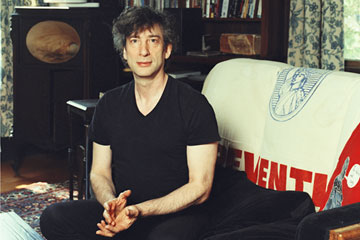
Author Neil Gaiman at his home in Cambridge, Mass.
(3 of 3)
One of Gaiman's particular strengths is his ability to write about magic in a way that feels properly magical. Not that magic is uncommon in fiction, but it's rare that a writer makes you feel the truly uncanny force of it, the sense that some deep and strange power is at work just behind the thin scrim of ordinary reality. Gaiman makes you feel it. Early in their investigations, Lettie leads the boy (who remains nameless) through the woods in search of the spirit, feeling her way with a stick. Gaiman registers the gradual transition from this world to somewhere else in subtle touches that, when taken together, set one's lizard brain keening:
"Are we there?" I asked.
"Not there," she said. "No. It knows we're coming. It feels us. And it does not want us to come to it."
The hazel wand was whipping around now like a magnet being pushed at a repelling pole. Lettie grinned.
A gust of wind threw leaves and dirt up into our faces. In the distance I could hear something rumble, like a train. It was getting harder to see, and the sky that I could make out above the canopy of leaves was dark, as if huge storm clouds had moved above our heads, or as if it had gone from morning directly to twilight.
When the tip of the dowsing wand bursts into flame, we know we're there. I ask Gaiman how he approaches writing passages like this, and he stresses the importance of not overdescribing--of treating unreal things the same way one would treat the real ones. "You don't make a fuss about it," he says. "The kid is just reporting what he sees, in that lovely, flat way that kids do."
Ocean is a short novel, not even 200 pages long, but like the Hempstocks' duck pond (or, for that matter, like Doctor Who's TARDIS), it's a lot bigger inside than it looks from the outside. It's a bildungsroman but in reverse gear: it's a novel about the truths--some wonderful, some terrible--that children know and adults do not, how we face them and master them and then, as we grow older, how we slowly but inexorably forget them. We take up residence in the mundane, unmagical world of adulthood. We lose our grip on the extremes of horror and ecstasy that children experience, and maybe mercifully, they slip away from us.
Or from most of us, anyway. "I remember reading books as a child and promising myself I wouldn't forget," Gaiman says. "Because you'd read books, and they'd obviously been written by someone who'd completely forgot. And I'd go, How can you forget?"