

Generous as I am, I hadn't counted on becoming a lender to government agencies and Fortune 500 corporations. You probably didn't either, but let me explain why you are. On a typical day, I get to work by way of New York City's magical subway system, paying my fare with a MetroCard, which is the only way you can get on the train. After leaving the Rockefeller Center station, I buy a coffee with a Starbucks app on my mobile phone. In Time's cafeteria, my cash is no good--I have to pay for lunch by swiping my corporate ID card. If I have to leave and return to the island of Manhattan by car, it usually requires paying a toll, which I do with an E-ZPass tag.
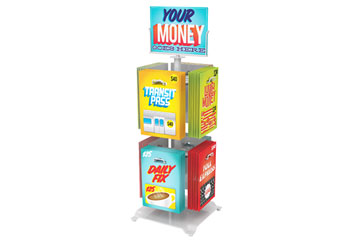
What these transactions have in common is that they are executed with stored-value cards. Whether it's the magstripe plastic card from New York's Metropolitan Transit Authority (MTA), the bar code from my iPhone or the transponder from my E-ZPass, I am required to regularly load each device with money from a credit card or bank account. At any given time, I probably have about $250 floating around on various stored-value cards. And I'm far from alone. These cards have been around for about a decade, but their popularity is soaring thanks to a combination of convenience, brand loyalty and a lack of other options. Last year, Americans spent $483 billion using stored-value cards, according to Mercator Advisory Group. That includes $184 billion on open-loop cards distributed by the likes of Visa and American Express and $299 billion in closed-loop cards like New York's MetroCard.
This trend is a boon for the entities selling transit passes and coffee cards. The MTA had a float of $231 million as of last December off of MetroCards, money the cash-strapped agency can use as operating capital. And it gets to keep the leftovers. This year it projects that it will net $52.2 million from expired, lost or unused cards--the electronic equivalent of coins in the sofa. Across the country, there has been so much money sloshing on stored-value cards that a legal fight keeps bubbling up in various states about expiration dates, fees and the states' right to abandoned property, known as escheat.
The cards are changing our economic behavior so much that the Federal Reserve has launched a study this year to analyze where the market is going.
The Fed might ask Starbucks. Last year, Starbucks' U.S. customers downloaded $3 billion onto the company's cards and apps. In its latest quarter, new-card activations and reloads increased 32% over the previous year as customers continued to switch to mobile payments. Consider that Starbucks' inventory totaled $1 billion in the same quarter. I could argue that I'm financing the Caffé Verona before I buy it, although Adam Brotman, Starbucks' chief digital officer, sees it differently. "The stored-value card really blossomed when we turned it into the epicenter of the customer relationship," he says. "We want to make sure we are being relevant and maximize the experience." That is, giving you offers and information tailored to your preferences.