

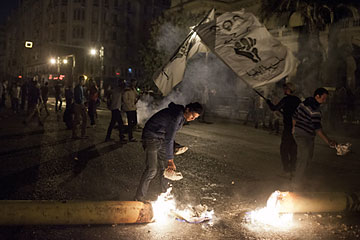
Liberal Egyptian revolutionaries have proved better at constant protesting than in the hard work of democratic politics
A year ago, tens of thousands of Egyptians took to the streets to protest the army's controversial interim rule and reclaim their revolution. When the army finally relinquished power after Mohamed Morsi won the first democratic presidential election later that year, most Egyptians — including the young liberals who'd sparked the revolution — were glad to see the generals go.
Fast-forward. Egyptian politics is now so polarized that a growing number of revolutionaries actually want a redo. In a nationwide survey by Cairo's Ibn Khaldun Center in March, 82% of respondents favored a return to military rule to start the transition all over again. The army, which produced all six autocratic regimes between a 1952 coup against the monarchy and the 2011 revolution, is widely seen as the last savior of the revolution. "Sometimes it's better to go back to autocracy and then start again," says Dalia Ziada, the Ibn Khaldun Center's executive director.
The egos and ineptitude of the revolutionaries have tragically sabotaged the historic uprisings that swept the Middle East two years ago. Parties are multiplying instead of consolidating. Squabbles are stalling vital reforms needed for the rule of law. Meanwhile, economies are in free fall, spawning deadly labor strikes and fears of bread riots. Thuggery and corruption are even worse than they were under anciens régimes.
Among the new political elite, the culture of "me, me, me" now threatens to destroy the embryonic spirit of "us, us, us" that in 2011 ousted four infamous autocrats who had ruled a total of 129 years. Democracy is only sustainable when individual rights are balanced by a sense of the common good. The imbalance has left all four countries in transition — Egypt, Tunisia, Libya and Yemen, which make up one-third of the Arab world's 350 million people — on the cusp of new crises. Regional behemoth Egypt is the closest to collapse. "We're reaching the point of ungovernability," says Amr Hamzawy, president of the Freedom Party and a member of the short-lived parliament dissolved by the Constitutional Court last year.
The backlash is partly against Morsi, who got off to a decent start last July until a power grab in November began a spiral of bad decisions. His Muslim Brotherhood government now appears ineffective, arrogant and isolated, relying on a tight inner circle to make decisions. But the sobering and even sorrier truth is that liberal and secular parties are failing as viable alternatives.
The new National Salvation Front (NSF) — a rickety umbrella for 10 parties and other smaller movements coordinated by Nobel Peace laureate Mohamed ElBaradei — seems to ignore democratic elections that its factions lost. It is better at threatening boycotts than either brokering compromise with the winners or campaigning in the countryside to recruit new members.
ElBaradei, who also heads al-Dostour, or the Constitution Party, warned again in late April that the coalition would not participate in parliamentary elections this fall unless its demands are all met — including the appointment of a new "neutral and credible" government, an independent prosecutor general and an acceptable election law. Despite presidential ambitions, he also noted last year that he did not vote in Egypt's first democratic presidential poll. He claimed to be standing on principle, but many Egyptians felt ElBaradei was suffering from sour grapes. "The dilemma for us in Egypt is that we have democrats who aren't liberals and liberals who aren't necessarily democrats," says Samer Shehata, a Georgetown University political scientist.
Younger leaders concede setbacks. "Some do believe the NSF is not ready, not capable of enunciating an alternative, not able to do more than craft statements in front of TV cameras and then go home and occasionally participate in elections," says Hamzawy. "I'm pushing them to move beyond sitting at conferences."
For now, the military appears reluctant to intervene, aware that the risks far outweigh the benefits. In the meantime, the failure of politicians both in power and in the opposition has left Egyptians fending for themselves. And dreams of the rule of law are increasingly imperiled by the transitional law of the jungle.
Wright, a fellow at the U.S. Institute of Peace and the Woodrow Wilson International Center for Scholars, is the author of Rock the Casbah: Rage and Rebellion Across the Islamic World