

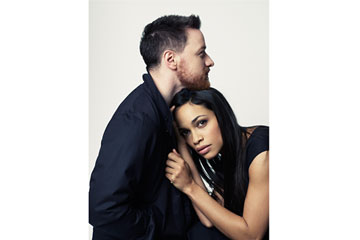
McAvoy and Dawson are a patient and therapist caught up in an art-heist conspiracy.
(2 of 3)
That ambiguity contrasts with his two previous films, which invite audiences to root for their dogged, daunted protagonists. In Boyle's 127 Hours (2010), James Franco plays a real-life adventurer who saws off his arm to escape certain death in a Utah canyon, and Slumdog Millionaire follows a kid from the slums of Mumbai to fame and riches on television. Both films have a strong sense of place, while Trance is stubbornly placeless: its main characters have Scottish, American and French accents, and Boyle shot in the Docklands and Tilbury Docks--areas of London less than instantly recognizable to Britons and foreigners alike.
But a reach back into his filmography reveals the untethered, morally ambiguous Trance as a kind of return to his roots. In his debut, Shallow Grave (1994), three friends do unspeakable things to their roommate's corpse as part of a scheme to keep a suitcase of his cash, and body horror abounds in Trainspotting's anarchic tale of thieving Scottish junkies. Trance's characters endure electroshock therapy, are divested of their fingernails and are buried alive. "You just feel victimized the whole time," says McAvoy of shooting the more brutal scenes. "It was horrible."
Weirdly enough, the gory intensity and mind-warp psychology of Trance may in some sense derive from Boyle's two-year stint in the belly of the Olympics. When he agreed to the opening-ceremony gig in 2010, he negotiated a contract that included two sabbaticals: one to mount a stage production of Frankenstein in London and one to shoot Trance. Filming, he says, became an antidote to the sterility of corporate meetings and the sugarplum sweetness of children dancing on beds in pajamas. "The two projects are linked in the sense of yin and yang," Boyle says. "While you're doing a nationally responsible, family-orientated celebration, it's wonderful to be able to go off and make a deliciously dark film at night."
Much of the particular delicious darkness of Trance is rooted in his devotion to film noir: its long shadows and mirrors and hermetically sealed moral universes. (The film's visual palette and looping structure owe a particular debt to a noir update from a decade ago, Christopher Nolan's Memento.) "What I love about noir, and what we borrow from it, is that stories happen in a bubble," Boyle says. "The actors have to sustain that bubble and make you believe it so it doesn't pop." True to noirish form, crime and sex mingle in Trance with potentially damning consequences, and Dawson's character--who appears to use her sexuality to manipulate the men around her--conjures a contemporary femme fatale: a heady mix of strength, vulnerability and gorgeous unknowability. The character's last name, Lamb, suggests a victim being circled by predators. But even a lamb can bite back. "She's not going to be able to match the men muscle for muscle. That's not possible," Dawson says of Elizabeth. "She can hold her own because she's intelligent and confident."