

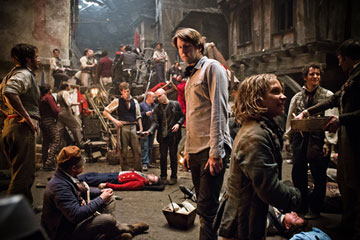
Behind the scenes of Les Misrables, the new movie.
(3 of 3)
The religious overtones of Les Miz also resonated with Hathaway, who was raised Catholic. Her close-knit family left the church in opposition to its anti-gay stance. "Where I'm at now is that I love all religions that don't hurt anyone. The religion of this film is love." (Or as Jean Valjean sings at the musical's end, "To love another person is to see the face of God.") "Fantine is such a mystical figure," Hathaway continues. "I believe that she burns with the same energy the martyrs burned with, that Joan of Arc burned with."
Jackman grew up watching faith in action too. His father, a single parent--"What he did was herculean, to bring up five kids with a full-time job"--was born again at age 30, inspired by Billy Graham's crusade. "I remember asking him if he told people at work he was a Christian, and he said, 'No. What you say is immaterial. It's what you do that matters.' If you think about it, that's very Valjean," he says.
And if Fantine lives among us today, so does Jean Valjean. "I was talking to Anne the other day about the New York City cop who bought a homeless man boots. It was on the cover of the New York Post, and there was Jean Valjean, right there," Jackman says. "It's a great honor to play someone like him, but it's a weird thing, during breaks, going back to your luxurious trailer just off set, like, 'Where the hell is my Evian?'"
"We live in a selfish age," Hooper says, "obsessed with how we project various versions of ourselves. But you have to tell this story from the point of view that God exists. And what God means in practice is the act of compassion, the struggle of living your life in a moral way."
Which is exactly what those young Parisians called for from the barricades. We have heard the calls, from Tahrir Square to Occupy Sandy. "Les Miz is the great anthem of the dispossessed," Hooper says. "It offers this solace that we as a collective can rise up against the system and change it for the better."
READ TIME'S INTERVIEW WITH ANNE HATHAWAY AT time.com/hathaway