

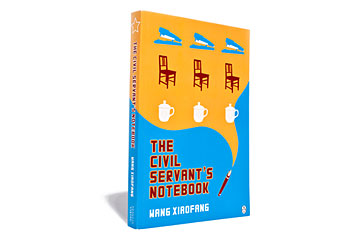
Wang Xiaofang's The Civil Servant's Notebook
News from China this year gave new meaning to the adage that truth is stranger than fiction. The Neil Heywood murder came right out of a spy novel, with the accused, Gu Kailai, not only a high-profile lawyer but also married to Bo Xilai, a controversial national-level political leader. The tale of blind lawyer Chen Guangcheng's escape, too, seemed conjured up by a novelist with a vivid imagination. He was imprisoned in a house surrounded by armed guards and high walls, and broke his leg during his getaway, but still made it to Beijing.
It's a third news story, however, related to the Heywood case, that Chinese readers are likely to think most resembles a novel come to life. Bo's expulsion from the Communist Party — and his pending trial for graft — mirrors the plot of several best-selling "officialdom novels." Among these is Wang Xiaofang's The Civil Servant's Notebook, which has just appeared in English.
In novels of this kind, skilled players of political games rise within a cutthroat bureaucracy. (Wang knows this milieu well, having once been private secretary to a provincial official who was later executed for gambling millions of dollars of public money at Macau casinos.) Many characters suffer dramatic reversals of fortune because of the machination of rivals, betrayal by erstwhile allies, a hubristic conviction of their invulnerability or the need by higher-ups for a scapegoat.
Commentators suggest that all those factors could have played a role in Bo's fall. But one key difference between Bo and his fictional counterparts should be kept in mind. The party claims that venality and infighting are rife only at relatively low levels of the bureaucracy. Cognizant of that, Wang, like other novelists who want their work to be published in China, knows better than to set his tales of malfeasance at the rarefied altitudes to which Bo ascended. In The Civil Servant's Notebook, the brass ring being sought is a cushy post of merely local importance.
Inevitably, because of the timing of its release, The Civil Servant's Notebook will be viewed through the lens of current events. That's fine. But much of it also veers off into the timelessly absurd. A dizzying array of narrators moves the action toward a climax in which some strivers rise and one key figure is sentenced to death. The most surreal chapters are narrated by inanimate objects. The book ends, for example, with the musing of the Government Car, happy to reveal what passengers say when they think only trusted confidants can hear.
My favorite chapter is made up of a dialogue between the Stapler and the Staple. The former is self-confident and quotes Hegel; the latter, which knows it will be destroyed if it does not stay perfectly in line, alludes to Kundera. It's fanciful terrain, yet one worth pondering in light of Bo's real-life fate.
Bo is accused of taking unfair advantage of his position as party head of the megacity of Chongqing. He fell, though, partly because his showy, self-aggrandizing style diverged so sharply from the conformist behavior expected of party leaders. In today's China, even Staplers are expected to act at times like Staples.
Wasserstrom is the author of China in the 21st Century: What Everyone Needs to Know