

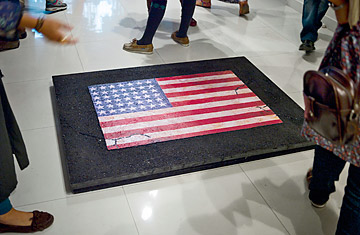
A U.S. flag painted on pavement by the Iranian regime is exhibited at the "America the Beautiful" show.
(2 of 2)
Art and politics overlapped directly in 2009 when one of the pro-democracy Green movement's leaders, former Prime Minister Mir-Hossein Mousavi, a painter, called his followers to the streets and nearly overthrew the government. Since then, he has been under house arrest at an undisclosed location. In those three years, almost any art with political themes has been exported rather than shown in Iran. After the uprising, Alireza Fani, a young artist living in northern Tehran, created a series of photographs depicting women, their heads bare, standing in the deserted streets where the protests took place. The tone is industrial gray, and gutted fish float in front of the women, representing the sexual assaults that happened during the crackdown. "I was told to keep them for myself — I couldn't show them in Iran," says Fani, whose previous works have sold for as much as $21,000 at auction at Christie's in Dubai.
"You have to be very careful," says Amirhossein Etemad, who owns Etemad, another well-known contemporary-art gallery in Tehran. "They would close the gallery," he says. "We send photos to the government. They control us. I turn down 30% of the art that's brought to me, as it's too edgy, too extreme." He owns a second gallery in Dubai, "where you can be freer. Not as free as London, New York or Paris. But freer than here." In early September, Etemad's Tehran gallery was showing bronze statues of mini swimming Buddhas by a famous Iranian actress while his Dubai gallery was showing a young artist's giant plastic Iranian coins. Covered in fur and trendy cell-phone covers, the coins were a commentary on the adolescent silliness and one-sidedness of Iran's currency policy.
Even the act of men and women mingling at the galleries can be dangerous, since it is banned by the government. There are no bars or clubs in Iran. Restaurants are for families, not dates. Over the years, music and cinema have been remolded into the regime's Islamist vision. Women can't sing in public unless no men are present or unless the female singers are part of a mixed-gender choir, and theater is practically a religious experience. "I came with some of my girlfriends," a 23-year-old woman in a green scarf and black-and-white dress told me at the "America the Beautiful" opening. She and her friends — mostly fellow engineering students at a nearby college — were huddled in a circle at the center of the gallery. As she spoke to me, a couple of them were making eyes at a group of young men near the garden door. "I like the art, and I like the chance to discuss it with others we meet," the woman said.
Just as contemporary art has become an outlet for dissent, creativity and even flirtation, so too has it become a sanctuary for anxious investors. The sanctions have trapped enormous capital in Iran. There are only so many golden coins rich Iranians can buy or construction projects they can invest in as inflation, by some estimates, tops 200% per year, though the official figure is 23.5%. Art is an investment that, if chosen wisely, can yield substantial returns over time. Four years ago, Iranian artist Farhad Moshiri's paintings and sculptures sold for about $5,000, says Noebashari of the Aaran Gallery. Now at auction his work goes for anything from $80,000 to $600,000. The market is also fueled by expatriate Iranians, many of whom view buying Iranian contemporary art as a form of patriotism. Iran is the largest producer of art in the region, accounting for at least a third of all Middle Eastern art sold by Christie's. "There are many wealthy collectors who only buy Iranian art," says Aquamarina Adonopoulou, assistant director of Dubai's Green Art Gallery, which represents several Iranian artists. "Some of it is truly avant-garde, and some of it just hitches to the political bandwagon. We try to find artists who produce for themselves and not for a fad."
Two little villages of galleries focusing mainly on Iranian art have formed in Dubai. And yet, when Iranian artists are invited to go and work in Dubai, they often decline. "The environment is important to their work," says Kourosh Nouri, owner of the Carbon 12 Gallery in the Emirates. "They say Dubai is too sterile, too staid." At home, there is no lack of inspiration, however terrifying that may occasionally be. The Green movement remains fractured and scattered, many of its leaders still imprisoned, under house arrest or closely watched by the Revolutionary Guards. Even at Aaran, when you ask what it means to show Iranian interpretations of the American Dream, the curator Toosi focuses on the American Dream rather than anything related to Iran. "The Founding Fathers had a dream, and it seems as if it is the only dream in the whole world that has come to life," he says. "That's the paradox — the dream vs. reality. The dream as reality, that's surreal." What does this say about Iranians' dreams for Iran? He shakes his head, "I cannot," he says — or perhaps he's afraid to — "answer that."