

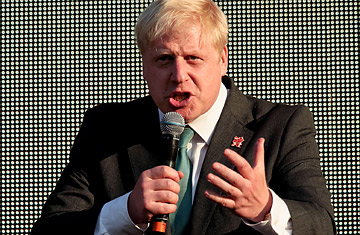
LONDON, UNITED KINGDOM - JULY 26: Boris Johnson, Mayor of London, addresses the crowd on the main stage stage during the Olympic Torch Relay Coca-Cola Concert at Hyde Park on July 26, 2012 in London, United Kingdom.
Carping is a British pleasure, and many of us were looking forward to enjoying a shambolic London Olympics with lip-smacking relish. To our surprise — and, never tell anyone I said this, to our slight pleasure too — the Games are going rather well. We are only nearing the halfway mark and the potential for disaster remains. Still, our transport system has not collapsed, and the organizers are making a decent fist of controlling a vast event. Outsiders see a confident country. For this brief interlude, we may believe it ourselves. But not for much longer. A small incident illuminates the wider malaise. Just before the Games opened, Boris Johnson, the flamboyant mayor of London, addressed an audience of 60,000 in Hyde Park. As he mocked the hapless Mitt Romney, who had dared to question whether London was ready to host the Olympics, the patriotic crowd chanted, "Boris, Boris, Boris!" For the first time since Tony Blair's heyday 15 years ago, ordinary citizens rather than party loyalists were roaring their approval of a British politician.
We may have to wait another 15 years to hear the roar repeated. Polls suggest the man most likely to become our next Prime Minister is Ed Miliband, a geeky, awkward pol hoping to return the Labour Party to its Blair-era highs. He's not a popular leader, as his net approval rating of minus 18% shows, just the least unpopular. The current Prime Minister, Conservative David Cameron, languishes at minus 27%. Nick Clegg, his Liberal Democrat coalition partner, is at minus 38%, an approval rating normally enjoyed by infectious diseases. In the U.K., confidence that any party has a workable plan is at record lows.
Once, our future seemed clear. We would commit to the E.U. We would abandon manufacturing and embrace services, especially the speculators of the City, whose apparent mastery of high finance bewitched a generation of politicians. Leaders, most notably Blair and his successor, Gordon Brown, believed that if they let financial services rip, the tax take would featherbed the welfare state. The mushy soft-left politics displayed before the wealthy spectators at the Olympic opening ceremony caught Britain's millennial combination of the corporate and the compassionate almost perfectly.
The 2008 crash crushed old illusions and paralyzed the British political class. They have not attempted to reform the banks by splitting them into separate retail and speculative divisions. Stopping bankers from leveraging high-street depositors' savings may make banks safer, but reform would mean that the City could never return to the wild days of the bubble our politicians yearn for. "We want to get back to normal," a senior official at the Bank of England almost bellowed at me after the crash. He did not realize that "normal" is over, dead and gone; that now there is no "normal" to get back to.
This dismal fact is taking a long time to sink into his political masters' heads. Britain's coalition came to power in 2010 promising that we could slim our way back to fitness. Austerity would allow a rebirth of private enterprise. The latest GDP figures show that whatever growth Britain had after the 2010 election has been lost, and we are in state of stagnation. Not that there is any public appetite to return to the free spending of the Labour days either. We tried that already, after all.
As for Britain finding a new role in the E.U., the failure of the euro zone to manage its currency has destroyed that dream. Our Europhile elite imagined a future of sophisticated French restaurants, sleek German cars and cool Scandinavian furniture. Now Greek debt and Spanish banks threaten to drag us down.
Britain's woes ought to be Scottish nationalists' opportunities. But the crisis has made plans for an independent Scotland seem a dangerous step into the unknown to most Scots. Alex Salmond, the leader of the Scottish National Party who once carried his country before him, appears unlikely to win any future referendum on independence. The failure of his hopes reflects a wider truth. The boom years' ways of doing business are everywhere dying, but stare as hard as you might, you cannot see what will replace them.
The Olympic opening ceremony made my point better than I could. Danny Boyle portrayed agrarian Britain, the Britain of the Industrial Revolution and the welfare state imaginatively. But when it came to modern Britain, the best he could offer were crass pop songs. The inability of a great director to say where Britain is going was not his failing alone. Britain's leaders are tongue-tied too.
Cohen is the author of You Can't Read This Book: Censorship in an Age of Freedom