

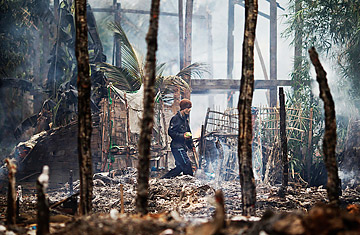
A man walks though a burnt Rohingya village during fighting between Buddhist Rakhine and Muslim Rohingya communities in Sittwe June 10, 2012. Northwest Myanmar was tense on Monday after sectarian violence engulfed its largest city at the weekend, with Reuters witnessing rival mobs of Muslims and Buddhists torching houses and police firing into the air to disperse crowds. Picture taken June 10, 2012.
BAILED OUT
1 | SPAIN
Authorities in the euro zone's fourth largest economy have repeatedly denied they would ever take a bailout. No more: on June 9 the Spanish government tentatively agreed to accept roughly 100 billion euros ($125 billion) in assistance from European Union emergency funds. Prime Minister Mariano Rajoy quickly spun the intervention as assistance to Spanish banks, not a bailout of the government's debt, something that could scare off private investment and lead to new euro-regulated restrictions. But after a brief rally in response to the loan package, investors are starting to question the mechanics of the loan--which will be monitored by the so-called troika team of inspectors from the E.U., the European Central Bank and the International Monetary Fund--and whether it can really solve Spain's systemic problems, like its shocking 24% unemployment rate and its slumping housing market. Meanwhile, tensions are rife throughout the rest of the E.U. as debt threatens Italy and a June 17 election looms in Greece that could be a prelude to that nation's withdrawal from the euro zone. With the loans to Greece (240 billion euros), Ireland (85 billion euros) and Portugal (78 billion euros), the debt crisis could cost the euro zone up to 503 billion euros ($630 billion) after the Spanish deal is finalized.
No One Wants a Czar
2 | RUSSIA
Some 50,000 Russians--including an array of liberal, leftist and nationalist groups--took to the streets of Moscow on June 12 to call for President Vladimir Putin's resignation and for political and judicial reforms. Before the march, the biggest since anti-Putin protests last winter that drew more than 100,000, officials searched the homes of opposition leaders and called in several organizers for questioning. Since starting his third term as President on May 7, Putin has taken an increasingly tough stance toward the opposition, including signing a new law imposing steep fines on protesters who harm people or property.
A Thwarted Coup?
3 | IVORY COAST
Authorities claim to have blocked a plan to overthrow President Alassane Ouattara just a year into his rule and create a transitional military authority. Several of the alleged coup plotters--exiled military officers and a close adviser to former President Laurent Gbagbo--were arrested. Meanwhile, clashes continued along the country's western border, where seven U.N. peacekeepers were killed in an ambush on June 8. Ivory Coast officials blame the violence on fighters still loyal to Gbagbo who had crossed over from neighboring Liberia. The ex-President is currently in the Hague awaiting trial on war-crime charges.
AUSTRIA
'We get the feeling they can't stand the sight of each other.'
HELGA HAPP, zookeeper in the town of Klagenfurt, after separating two 115-year-old giant turtles--mates for most of their lives--that were in danger of killing each other
Smoldering Ground
4 | BURMA