

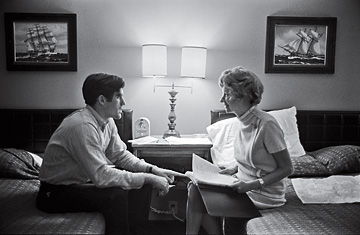
On the campaign trail during his mother's Senate bid, Mitt and Lenore strategize in a hotel room
(3 of 11)
Through his early 20s, George chased his quarry from Salt Lake City to Washington, where she earned a degree in English at George Washington University, and then to Hollywood, where Lenore in her early 20s began to win small parts alongside movie stars like Greta Garbo. Subdued at last after seven years, she turned down a $50,000 contract with Metro-Goldwyn-Mayer--$750,000 in today's dollars--to be sealed in the Mormon Temple for "time and all eternity" to a salesman earning $125 a month. They were married in 1931.
For the next 64 years, they had "truly one of the world's great love affairs," says Peter Fletcher, who entered Michigan politics as George's advance man. George serenaded Lenore with "Moonlight and Roses" and scattered love notes like petals under her pillow. A maid on Mackinac Island, where the couple spent summers, found a typical one: "Darling, have gone to the grocery store. I will love you eternally. George." One day Lenore showed off a bedroom closet full of "beautiful negligees of all colors and descriptions, and she said, 'George always gives me those,'" recalls her friend, now named Joyce Braithwaite-Brickley.
George moved his family to Detroit in 1939, joined the auto industry and made a fast climb to chief executive of American Motors, where he saved the company with an audacious bet that drivers would trade their "gas-guzzling dinosaurs" for a compact Rambler. Lenore, meanwhile, bore three children before a doctor warned that "her condition would not permit her to have another child," George wrote to family members and close friends. Against the odds, Lenore became pregnant again and delivered Willard Mitt Romney on March 12, 1947.
Immediately afterward, George wrote, she required a "major operation" that could have killed her. The details of that surgery have never been made public.
Lenore was a strong-willed woman, better educated than her husband and uncommonly independent for her time. But George was a tsunami, washing over all obstacles. They squabbled often, despite the romance. "It was a quiet, intense exchange," recalls Fred Grasman, who lived with them for a time as George's driver. "She would, having said her piece, accept what he wanted. I don't think it could have been any other way. George was not a person who would willingly abandon a position."
There was more to it than that. Lenore acquiesced by choice, believing it her duty in a temple marriage that looked toward exaltation, the Mormon term for eternal life with her mate and children. "If he depended upon me for the greatest thing of all--happiness--he was going to get it," she wrote in an unpublished manuscript in the summer of 1972, the year of Ms. magazine and the Equal Rights Amendment. "A wife is a vital part of her husband's development--his self-esteem and self-image ... One might ask, 'What about her happiness?' Certainly it is realized in ... being capable enough and loving enough to be able to respond to the needs of her mate and children."