

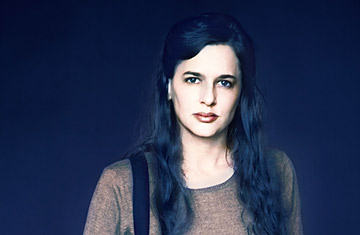
Have Lens, Will Travel. To produce the hundreds of portraits in A Dead Man Declared Dead and Other Chapters, Simon visited 25 countries in four years. Even a single bloodline might have members scattered across several nations.
(2 of 3)
Then comes the delicate part, persuading people to take part in that odd postmodern phenomenon, the conceptual art-documentary photo project. Some of her subjects, like the "living dead" in India, were happy to publicize their predicaments. Others, not so much. Some descendants of Hans Frank, Hitler's personal legal adviser, who was executed after being convicted of war crimes at Nuremberg, weren't keen on advertising their Nazi ancestry. So you might say they came halfway out of the closet: they declined to be photographed but sent Simon articles of their clothing instead, which she put before her camera in neatly folded individual bundles. "They respected what I was trying to accomplish," she says. "They just didn't want to be physically present." Simon didn't have the same problem with one of her oddest bloodlines: laboratory rabbits infected with a deadly virus by researchers looking to reduce Australia's massive overpopulation of rabbits in the wild.
But even when Simon had the full cooperation of her subjects, other perils sometimes emerged. In Tanzania, she photographed the bloodlines of albinos, who are sometimes preyed on by ghoulish poachers who kill them to sell their hair and body parts to healers; because the subject is a touchy one with Tanzanian authorities, Simon had to sneak her bulky cases of gear across the border from Kenya. In Bosnia, where she tracked down the mother of four sons killed in the Srebrenica massacre, she had to arrive clandestinely at the woman's home. "Though it was a decade since the massacre and this woman had lost everything," she recalls, "there was an incredible fear of retaliation."
Simon's own bloodline has its share of avid photographers, including her Russian-immigrant grandfather, who owned a pinball arcade in Times Square and was an amateur naturalist who built his own telescopes. "He was always collecting images with very precise data," says Simon, who grew up in the New York City suburb of Dix Hills, N.Y. "My father also took pictures constantly, but his were more about environments and people around the world." For a time he worked for the State Department; the slide shows he brought home from Russia, Southeast Asia and the Middle East so captivated his daughter that after she arrived at Brown to study environmental science, she also pursued photography at the Rhode Island School of Design. By the time she graduated in 1997, Simon was committed to the camera, though she wasn't yet sure what she wanted to do with it.
Simon's big break came a few years later when the New York Times Magazine assigned her to produce a series about people who had been exonerated after serving time--sometimes many years--for violent crimes they didn't commit. That led to her first book, The Innocents. In the decade since, Simon has become a well-established name in the art world. Her gallery is the mighty arsenal of Larry Gagosian, and A Living Man Declared Dead has already made stops at the Neue Nationalgalerie in Berlin and the Tate Modern in London.