

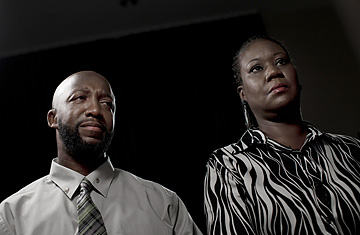
Trayvon Martins father Tracy Martin and mother Sybrina Fulton on March 25 in Sanford, Fla.
(2 of 4)
The "stand your ground" law passed at a peculiar time in Florida--a time propitious for Second Amendment purists. On Sept. 16, 2004, Hurricane Ivan crashed into northwestern Florida. A brutal storm, Ivan killed 25, and damages exceeded $18 billion. Looters raided businesses and homes in and around Pensacola, as people did in New Orleans when Katrina struck a year later.
Reporters began to fixate on one story, that of James Workman, 77, who shot and killed a man who broke into an RV where Workman and his wife were staying after Ivan took their home.
Workman was clearly protected under the castle doctrine, but authorities struggled with whether they should take him into custody or charge him. Dennis Baxley, a member of Florida's house of representatives, says Workman was in legal limbo for weeks. Even though prosecutors eventually declined to charge Workman, Baxley co-sponsored the bill that would become the "Stand your ground" law.
"We wanted citizens to know that if they are attacked, the presumption will be with them," says Baxley.
But Workman's case obscured a deeper political agenda. The National Rifle Association had been working for years to advance the idea that the castle doctrine didn't offer adequate presumption of innocence to gun owners.
The NRA had amassed great power in Florida's legislature. In 1987, the organization successfully backed a landmark state law that allowed Florida citizens to carry a concealed weapon into virtually any public space. Applicants for a concealed-weapons permit had to pass a background check and were screened for criminal records and mental illness.
The gun lobby's clout in the state owes a lot to Marion Hammer, a Tallahassee lobbyist who served as the first female president of the NRA in the 1990s. Hammer, a tiny, gray-haired grandmother who once joked that the key to the gun debate was to "get rid of all liberals," helped craft "Stand your ground" and then persuaded lawmakers to back it, according to gun-control advocates. "Her sway in the Florida legislature has been instrumental for the NRA," says Brian Malte, director of legislation at the Brady Campaign to Prevent Gun Violence. "It's why the NRA has used Florida as its laboratory."
By 2001, when Zimmerman graduated from Osbourn High School in Virginia and moved to Florida, the state had become the most gun-friendly in the nation.
Unintentionally, Florida also created a huge loophole for criminals. "Stand your ground" quickly became a favorite among defense lawyers representing gang members, spouse abusers and drunks, who could now claim that ordinary disputes in private residences or businesses--"any other place" besides the home, according to "Stand your ground"--provided the right to "meet force with force." In 2004, the year before "Stand your ground" became law, Florida authorities deemed eight homicides justifiable. In 2010, 40 homicides were called justified.