

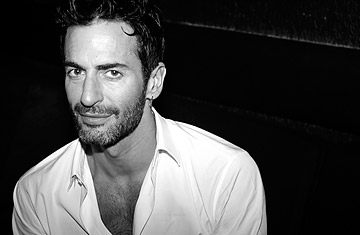
It's the last day of New York Fashion Week, and as is customary, the fashion world is burbling about Marc Jacobs' runway show, where he presented his fall-winter 2012 collection. But this time the chatter is centered less on the clothes--metallic paisley prints, Pilgrim shoes with rhinestone buckles, oversize fur hats--than who was wearing them: two of Jacobs' models were younger than 16, the minimum age suggested by the Council of Fashion Designers of America.
Over coffee at the Mercer Hotel in SoHo, Jacobs (dressed in head-to-toe black, including a Commes des Garons kilt) is unrepentant. "You have child actors and children who model for catalogs," he says. "What's the difference between doing a commercial for peanut butter and being on a runway?"
Surely he was trying to be at least a little bit provocative? "No, I was just kind of doing what I felt," he says, adding without a hint of irony, "I don't ever mean to be provocative."
That's a provocative statement. But spend some time with the tattoo-covered, formerly tabloid-prone Jacobs--often cited as the most influential American fashion designer of his generation--and a portrait emerges of an intuitive, firmly in-the-moment personality, not one for much soul searching or second-guessing. Those fearless instincts gave rise to his "grunge" collection for Perry Ellis in 1992: baggy silk plaid shirts, cashmere thermal underwear, skullcaps. It got Jacobs fired from the company--and established him as a brilliant young talent. Five years later, he was appointed artistic director at Louis Vuitton and relocated to Paris for part of the year. "At the time, I was working with my business partner, Robert Duffy, in a tiny loft on Spring Street with just two sewers, one pattern maker and one person helping with sales," says Jacobs, now 48. "I was quite shocked by the absurdity of it all."
Absurd or not, the Manhattan-born Jacobs transformed one of France's oldest and most iconic labels (founded in 1854) from a conservative maker of luggage and leather goods into a fashion ecosystem, with a ready-to-wear line for women (Jacobs' first was a landmark in gauzy luxury), menswear, shoes, fine jewelry and perfume. His 15-year anniversary with Vuitton is celebrated at "Louis Vuitton--Marc Jacobs," a new exhibition at Paris' Museum of Decorative Arts through Sept. 16.
Jacobs opened his first eponymous store in SoHo the same year he arrived at Vuitton. Today there are more than 200 of his stores in 60 countries, and Jacobs is as famous as the brand names he dresses, including British It girl Alexa Chung, actress Rachel Weisz and socialite Paris Hilton. And in a true and rare sign of deference, celebrities and fashion editors show up on time for his runway presentations. Even Vogue editor Anna Wintour, who has been known to literally run out of fashion shows, stopped backstage to chat with Jacobs after he took his bow at New York Fashion Week. Grace Coddington, Vogue's creative director, seemed turned off by the swarming crowd and ducked out. "This is a s--- show," actor Michael Pitt remarked amid the frenzy.
Given these mob scenes and his famous associates, one might assume Jacobs to be a highly social creature in his personal life too. Not true, he says. "I have many acquaintances, and I've met a lot of people, but I have very few close friends."