

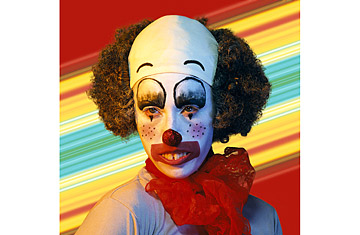
Untitled #424 (2004), by Cindy Sherman
Cindy Sherman takes pictures only of herself, but she always insists she doesn't make self-portraits. It would be truer to say that for the past 35 years, she's been producing a portrait of her times as they flow through the finely tuned instrument of her baroque psyche. Again and again in her spine-tingling retrospective at the Museum of Modern Art (MOMA) in New York City--it runs there from Feb. 26 to June 11, then travels to San Francisco, Minneapolis and Dallas--you also discover she's made a portrait of you.
Growing up in a New York suburb, Sherman loved to play dress-up. In 1977, when she was 23 and just out of Buffalo State College, she started playing it with a vengeance. For three years, she photographed herself in costumes, wigs and settings that drew from the deep pool of movie images we're all immersed in from childhood. In what eventually grew to a series of 70 "Untitled Film Stills," she took on the role of career girl, housewife, siren and woman on the verge of a nervous breakdown. Six years before Woody Allen got there, she became the Zelig of the collective unconscious, the heroine with a thousand faces.
Sherman wasn't interested in campy genre re-creation. Any number of drag performers had already nailed that act. It was a subtler kind of female impersonation she was after. That's why there are few distinct genres or stock characters in the "Untitled Film Stills"--no sci-fi, no cowgirls, no obvious gun molls. And though in some images she seems to channel Hitchcock blondes and in others moody beauties like Monica Vitti and Anouk Aime, none of the pictures reproduce scenes from actual films. Their power is in their ambiguity. What they re-create is not a specific movie memory but the primordial soup of images from which we cook up ourselves. And though obviously it's the sources of female identity she was attempting to unravel, in the process she deciphered a media code that constructs us all.
By 1995, when MOMA reportedly paid what was then the newsmaking sum of $1 million for a full set of the stills, Sherman was well established as one of the pivotal artists of her generation. She had made the leap into museum collections long before, with a 1981 series inspired by the centerfolds in skin magazines. But the weirdly spotlit young women she becomes in those pictures are fully dressed and acting out psychodramas of yearning and anxiety never dreamt of in the Playboy philosophy.
There are galleries in the Sherman show, which was organized by MOMA associate curator Eva Respini, that go off in your head like bombs. Sherman's universe of enigmatic faces and wiggy characters appears in prints that are big--6 ft. tall and more. The colors can be harsh and aggressive. Though she sometimes offers herself quietly to the camera, her face as round and innocuous as an aspirin, she can also look feral, sinister and unhinged. The unclassifiable specimen she becomes in Untitled #359 doesn't look human so much as like some mad approximation of humanity.