

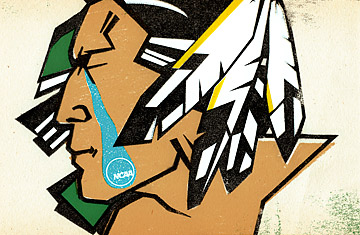
Indian Sports Logo by Gregory
For years, college and professional sports teams have taken heat for caricaturing Native Americans with their nicknames and mascots. Even so, we still have the Washington Redskins, and the Cleveland Indians haven't scrubbed the cartoon Chief Wahoo from their caps. In other instances, tribes have sanctioned a team's use of a nickname, as with the Florida State Seminoles and the Utah Utes.
But what about the puzzling case of the University of North Dakota (UND) and the Fighting Sioux? Spirit Lake, the Sioux reservation closest to the UND campus in Grand Forks, supports the name. Yet on Jan. 1, the school formally dropped it, to the disappointment of those for whom "the Fighting Sioux" represented victory and civic pride.
On the surface, the name and branding seem harmless. (Many Irish Americans, for example, bleed Notre Dame green and ally themselves with the school's leprechaun mascot.) UND's logo, a headshot of a stern-looking Sioux warrior designed by a Native American alum, is simple, classy and iconic. So why is it being phased out?
For Spirit Lake tribe members, the blame rests with a familiar foe: the National Collegiate Athletic Association (NCAA). In 2005 the NCAA urged that UND and 17 other schools--including Florida State and Utah--scrub their American Indian imagery and mascots. If they refused, the schools would be ineligible to host lucrative postseason events and forbidden to use their names or logos during postseason play.
UND sued the NCAA. In a settlement, the NCAA stated that for the university to keep the Fighting Sioux name without facing sanctions, it would need the approval of both Spirit Lake and Standing Rock, another Sioux reservation in North Dakota. In 2009 Spirit Lake put the question to a full tribal vote. By a 2-to-1 ratio, members voted to keep the name. Standing Rock's tribal council voted to eliminate the name; it did not, however, put the question to a full tribal vote, to the dismay of Standing Rock tribe members in favor of the Fighting Sioux moniker. "It's not right for people not to have a say," says Archie D. Fool Bear, a member of Standing Rock. (The chairman of the Standing Rock tribal council did not respond to an interview request.)
Opponents of the nickname cite instances in which fans of UND's archrival, North Dakota State (nickname: the Bison), defaced the Fighting Sioux logo on T-shirts. Those may have been isolated events, and Bison fans are not the first to mess with a rival's brand. But if UND made way for a less historically and culturally charged mascot, racist taunts would no longer be an issue. "The name and logo breed prejudice," says B.J. Rainbow, a UND student and Native American with blood ties to both Standing Rock and Spirit Lake.
Many other UND students, especially non--Native Americans, and Grand Forks residents are in mourning. To them, the Fighting Sioux logo is not unlike the G on Green Bay Packers helmets. "You can't overstate how obsessed Grand Forks is with UND hockey," says Allison Davis O'Keefe, a photojournalist who spent 15 months chronicling the team--which has won seven national championships--and the controversy. "If we're not the Fighting Sioux, who are we? It's a loss of identity."