

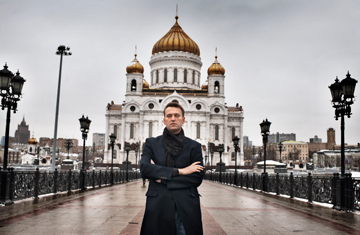
Fed up Alexei Navalny in front of the Cathedral of Christ the Redeemer in Moscow
(2 of 2)
As of November, about 70 million Russians — half the population — had Internet access; 55 million of them were actively surfing the Web, often to look for news and analyses free of the propaganda shown on state-controlled TV. Russia's favored blogging site, LiveJournal, has emerged as the only truly free and democratic medium for political discourse in the country, with about 30 million readers a month. Through his online campaigns against corruption, Navalny became an Internet folk hero.
In November 2010 he posted evidence on his blog of a $4 billion embezzlement scheme at a state corporation, causing a sensation in the Russian and international press. A month later, he launched his most famous website, RosPil, which changed the face of online activism. It allowed readers to dissect government tenders — like orders for a fleet of cars or diamond-encrusted wristwatches — for signs of corruption or embezzlement. In just over a year, the site's lawyers and volunteers found irregularities in state contracts worth about $1.3 billion, according to RosPil's tally. Many of those tenders have since been annulled.
Like most of Navalny's campaigns, RosPil stood out for its pragmatism. Instead of the polemics and pamphleteering that preoccupy most of Russia's old-school opposition groups, Navalny focuses on specific issues, such as corruption and potholes, and invites his fans to help redress them with the crowdsourcing power of the Internet. Early last year, when he put out a call for donations to hire lawyers for RosPil, he raised $230,000 in two months, with the average donation being less than $10. "Masses of people were basically hiring me as a sheriff to do the oversight work the government was failing to do," Navalny says.
With their donations, Navalny's online supporters had taken that step from idle blogging to political action, and that is when Russia's security services began to take notice. In the spring of 2011, Yandex.Dengi, the Russian equivalent of PayPal, received a request from the FSB, the main successor to the Soviet KGB, to hand over the personal details of everyone who transferred money to Navalny's website. Yandex complied, and the people on that list soon began getting phone calls demanding to know why they supported Navalny. But the harassment backfired. Donations began pouring in many times faster. Official attempts to get dirt on Navalny uncovered little except that his parents' grocery store sold vodka after legal hours.
His main vulnerability has been his strident nationalism, which has always been at the core of his views. In 2007 he co-founded the National Russian Liberation Movement, known as NAROD, and published its manifesto on his blog. It focused mostly on immigration policy, declaring that "those who come into our home but do not want to respect our law and traditions must be kicked out." It also called for all law-abiding citizens to have the right to bear arms. Navalny owns several, and in 2007, when a group of thugs broke up a political debate he was hosting, he shot one of them four times with a traumatic pistol, a nonlethal weapon that fires rubber bullets. After a lengthy investigation, all charges against him were dropped.
But the incident fueled fears that he is a right-wing fanatic, and after the December demonstrations, slick cartoons started circulating online depicting Navalny throwing the Nazi salute and wearing a T-shirt that reads I'M A FASCIST. Navalny laughs this off as ignorant fearmongering. "People aren't really afraid of my views," he says. "They are just afraid of the word nationalism," which they associate with some "abstract nationalist menace." But his oratory style has not done much to help. During both the protests he addressed last month, his speeches dissolved into frenzied screaming, which spawned comparisons to Hitler. "We don't want to wait!" he shouted. "We don't need any parties! This is our party! What other parties do you need?" A couple of weeks later, he seemed to regret the vitriol. "I know some people got scared," he told TIME in his meager office, where he runs a small legal firm. "I got too emotional, but what can I say? I really hate the people in power. I hate them with every fiber of my being. That is what drives me in almost everything I do."
Navalny has said he will run for President only when he is sure of an honest vote. He concedes that Putin, with no viable competitors, will likely win a third term in March. But that will simply continue to discredit Putin, he says, adding, "This will not be a legal presidency."
Though his political instincts are keen, Navalny is just emerging from the firebrand politics of the blogosphere, and he often sounds more like a hothead than a statesman. But his hatred for Putin's system is shared by a large and growing segment of the Russian electorate. No one can say whether that energy will be channeled into a revolution, into real democratic reform, or whether it will simply dissolve into feuding camps. But one thing is clear: Navalny has brought the anger out of the Web and onto the streets. There is no easy way to force it back.